Toys for teaching math turn abstract concepts — numbers, operations, fractions — into concrete, hands-on experiences. Physically moving objects to discover that 3 + 4 = 7 is often far more meaningful than reciting a number fact. These tools benefit every child, especially those who learn best by doing: kids with ADHD, autism, dyslexia, or simply those who feel anxious around numbers.
"I'm just not a math person." How many children — and adults — carry that belief like a weight? Yet behind that feeling often lies something straightforward: math was taught too early in abstract form, with symbols on a page, before the brain ever had a chance to touch the ideas. Research in education suggests that many children grasp numerical concepts more easily when they start with their hands and direct sensory experience.
That is exactly where toys for teaching math come in. From the monkey balance to Cuisenaire rods, oversized dice and colorful abacuses, these tools transform a math lesson into a playground. This article walks you through the best categories of math toys, how to choose them by age, and how to weave them into daily life at home and in the classroom.
Why play is the best way to learn math
Math anxiety is a real phenomenon, documented from the first years of school. A 2013 study of first- and second-graders (Ramirez et al., Journal of Cognition and Development) found that math anxiety was already linked to lower math achievement at that age. The good news? Math anxiety is not a fixed trait: how math is presented — and how anxious the adults around the child feel about it — plays a real role.
Concrete before abstract
Educators call this the Concrete–Representational–Abstract (CRA) continuum. Before a child can make sense of "5 − 3 = 2" on paper, they need to physically remove 3 counters from a group of 5 and see that 2 are left. That physical step helps anchor the concept in long-term memory in a way that repetitive drill alone rarely does.
Play engages multiple channels at once
When a child uses a balance scale to weigh objects, they engage vision (watching the pan tilt), touch (placing the weights) and reasoning (predicting what will happen). This multimodal input can be especially helpful for children with ADHD or autism spectrum disorder (ASD), for whom hands-on activity often makes it easier to sustain attention.
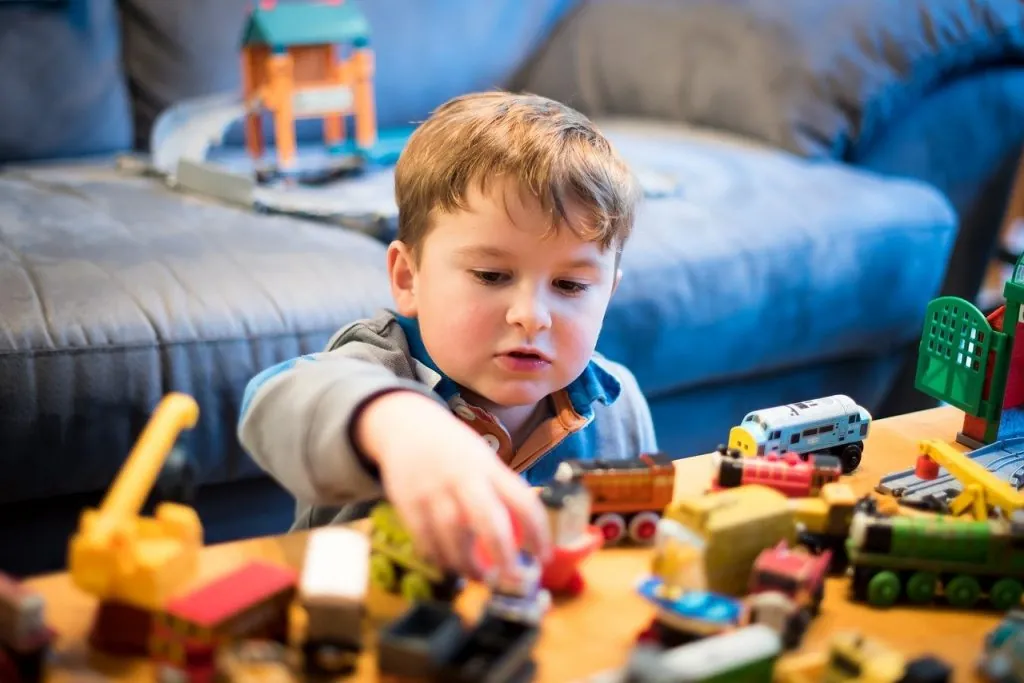
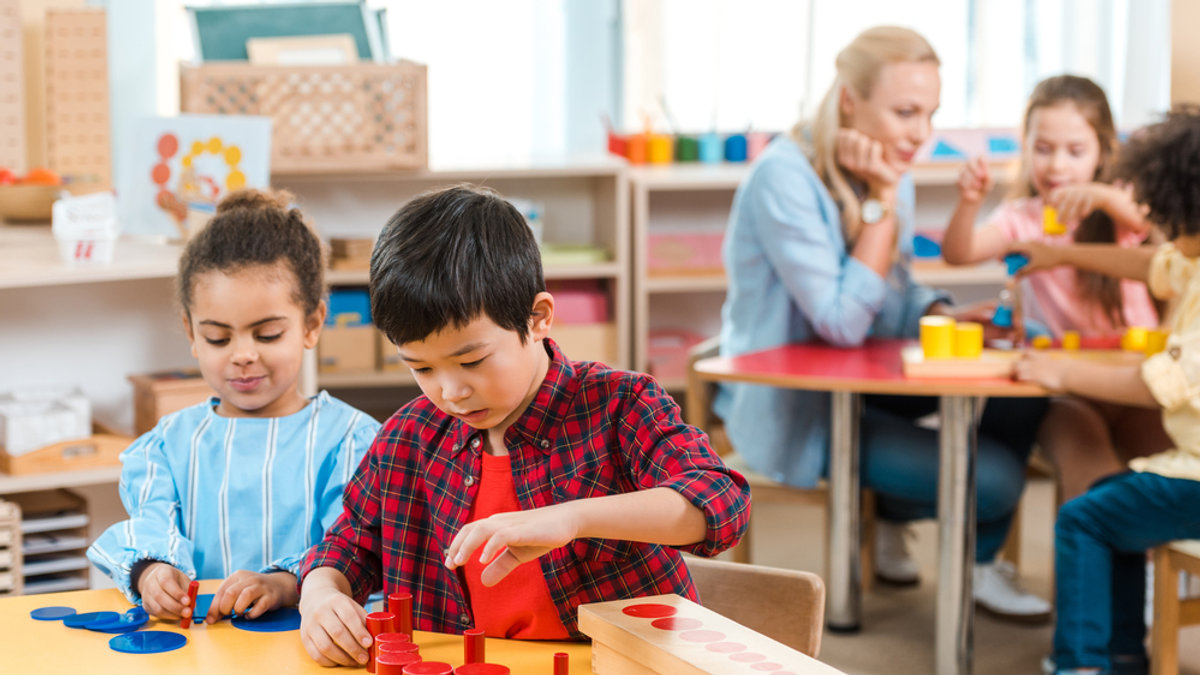
Did you know? The Montessori method places concrete materials at the heart of math learning. A 2023 systematic review of 32 studies (Randolph et al., Campbell Systematic Reviews) found that Montessori education had a positive effect on academic outcomes, including math, compared with traditional education — about a quarter of a standard deviation on average.
Counting toys: building the foundation in preschool
Before a child can add or subtract, they need to master one-to-one correspondence — understanding that each object represents one unit and that the last number said tells the total quantity. This is the bedrock of all number sense.
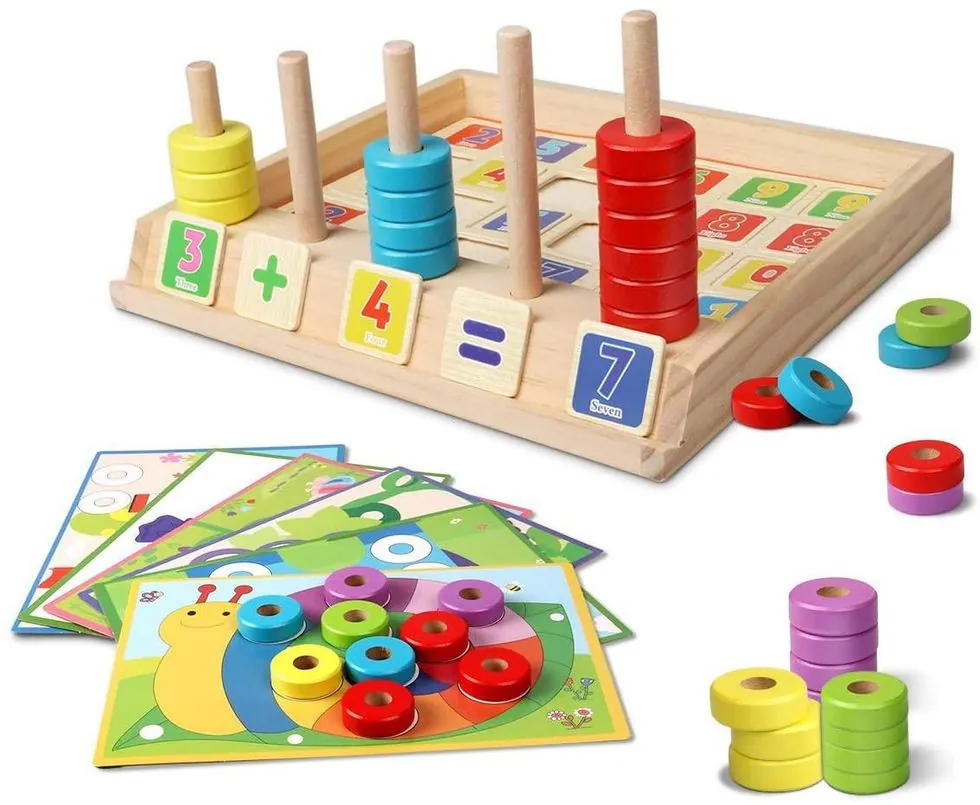
Linking cubes and counting counters
Interlocking cubes in different colors are among the first math tools a young child can hold. Snapping together a tower of 5 red cubes and 3 blue cubes lets them see and feel that 5 + 3 = 8. The same cubes work for comparing quantities, exploring "greater than" and "less than," and even introducing early measurement concepts.
Abacuses and bead frames
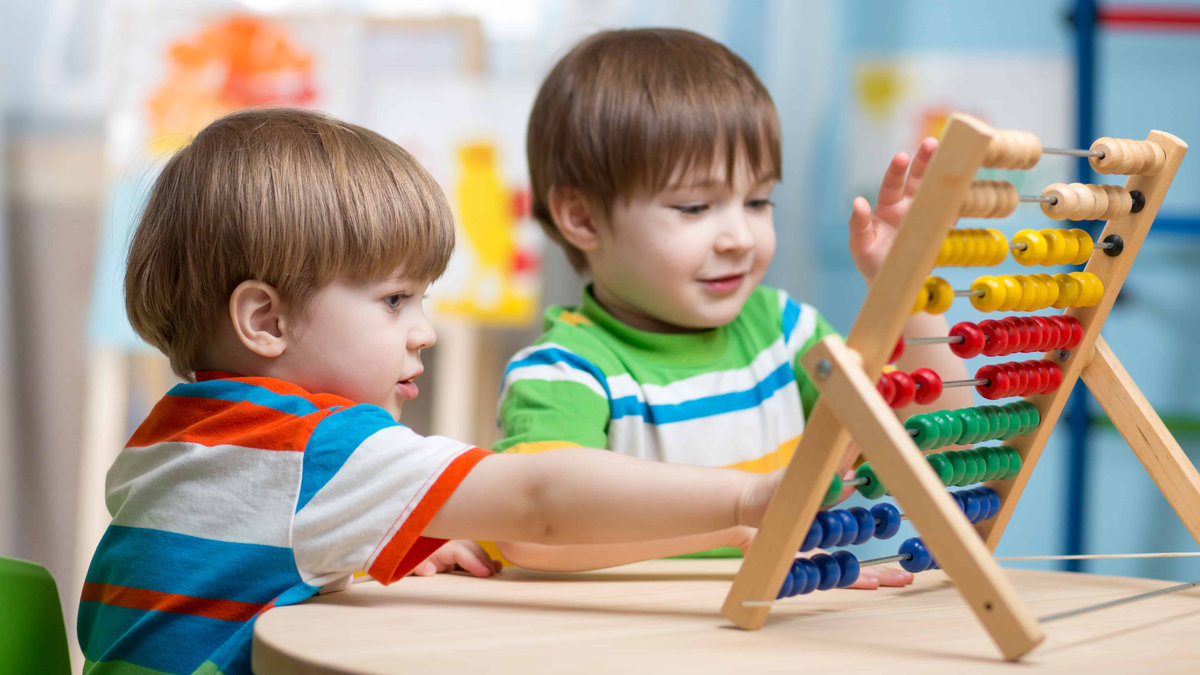
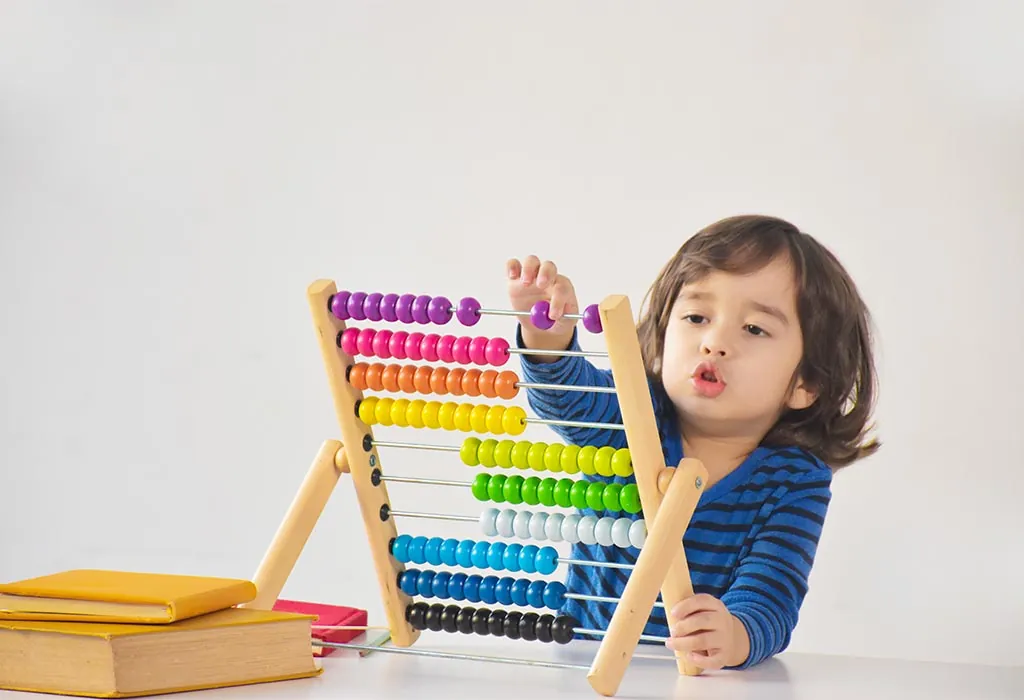
The abacus is one of the oldest math tools ever made — and still one of the most useful. A 100-bead abacus organized in rows of ten gives a child an immediate, visual model of our base-ten number system. They slide beads to add, subtract, and eventually discover multiplication as repeated addition — all without writing a single digit.
- 20-bead abacus — ideal for ages 3–6; builds counting to 20 and first additions.
- 100-bead abacus — for ages 6–9; illustrates tens, hundreds and place value.
- Fraction bead frame — for ages 9–12; makes fractions visible and directly comparable.
Sorting games and the pretend shop
Toys with different shapes, colours and sizes turn sorting and classifying into a game — a key step toward understanding sets, patterns and data. A pretend toy store adds another layer: children count coins, make change and add up totals, practising real-life math without even noticing.
The math balance: understanding operations through equilibrium
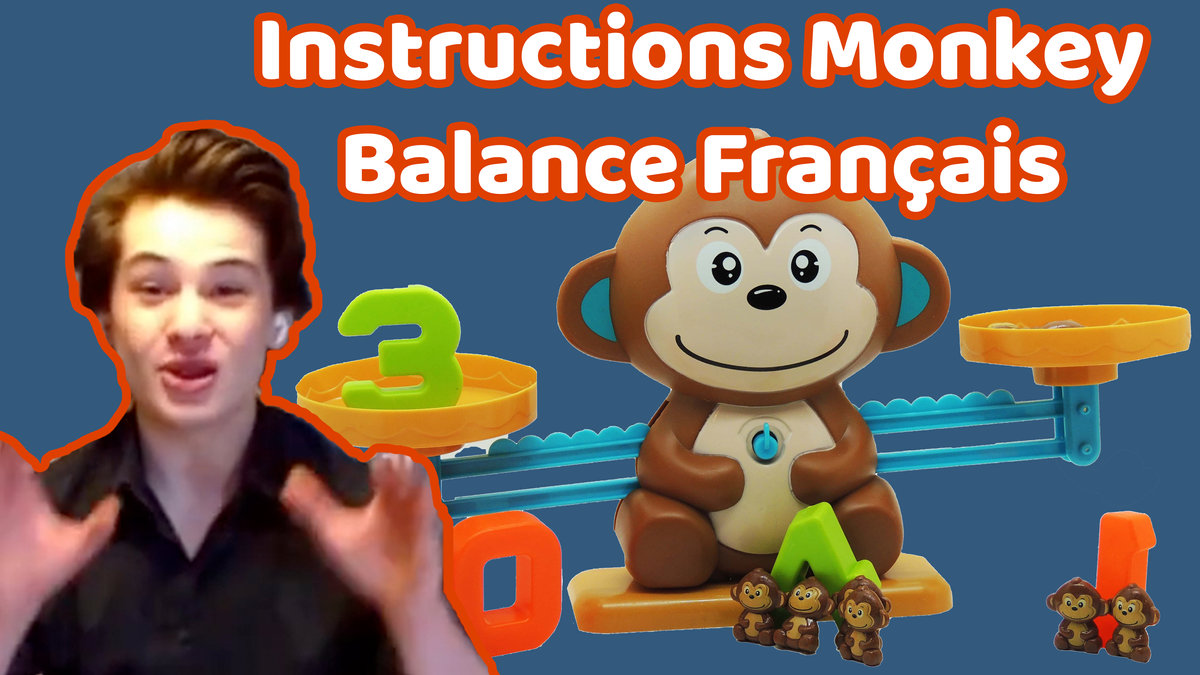
The math balance — often called a monkey balance — is one of the most versatile teaching toys available. Its concept is beautifully simple: two trays sit on either side of a central axis, and the child places number pieces on them. If the left tray holds the 7 and the right tray holds the 4 and the 3, the scale balances — showing that 7 = 4 + 3.
This single tool lets children explore:
- Addition and subtraction: finding which weights make the scale level.
- Commutativity: discovering that 3 + 5 and 5 + 3 produce the same balance.
- Early equations: "What is missing on the left side to make them equal?"
- Fractions and ratios with more advanced versions of the scale.
With a monkey balance, a five-year-old intuitively grasps what a lecture-based first-grade lesson might struggle to convey. The body understands before the mind catches up. — The Robiii team
For a step-by-step guide to activities with this tool, see our Monkey Balance instructions article, which walks you through games for every level.
Number games and operations for primary school
Once counting basics are solid, primary-school children need tools that build fluency with operations while keeping engagement high. Math card games, polyhedral dice and number puzzles are perfect for this stage.
Polyhedral dice
A simple 10-sided die turns any kitchen table into a practice arena for addition and multiplication facts. The child rolls two dice and adds (or multiplies) the results. The speed and variety of combinations hold attention long after a worksheet would have been abandoned. For children with ADHD, the randomness of the dice adds welcome novelty — you never know what's coming next.
Cuisenaire rods
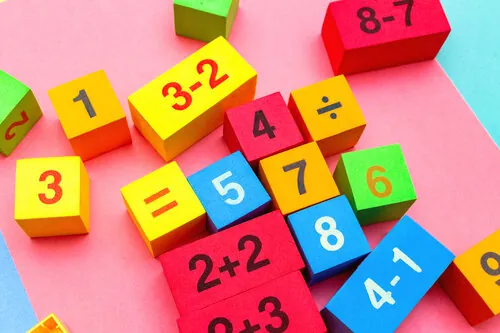
These small colored wooden or plastic rods — each length corresponding to a number from 1 to 10 — are a timeless classic. A child can physically see that two red rods (2 + 2) match the length of a purple rod (4), locking in the notion of equivalence in an unforgettable way. Rods also work for exploring multiples, factors and fractions without ever writing a numeral.
Math dominoes and puzzle cards
Math dominoes replace the classic dots with operations ("3 × 4") and their results ("12"). A player matches the right domino by solving the operation — disguised practice that racks up dozens of mental calculations in a single game.
Pattern blocks, geoboards and 3D shapes for geometry
Toys make geometry come alive too. Pattern blocks introduce shapes, symmetry and tessellations as children create their own designs. A geoboard and a handful of rubber bands let them build polygons and explore perimeter and area. And building blocks or 3D models help them discover the faces, edges and vertices of cubes, prisms and pyramids.
| Tool | Best age | Concepts covered | Teaching lifespan |
|---|---|---|---|
| Linking cubes | 2–6 years | Counting, comparison, measurement | Very long (versatile) |
| 20-bead abacus | 3–7 years | Counting, addition, subtraction | Long |
| Monkey balance | 5–12 years | Operations, equations, fractions | Very long |
| Cuisenaire rods | 5–12 years | Operations, multiples, fractions | Very long |
| Polyhedral dice | 6 years + | Addition and multiplication facts | Indefinite |
| Math dominoes | 6–10 years | Mental math, fact recognition | Medium |
Math toys for children with special needs
Children with ADHD, ASD, dyslexia or dyscalculia benefit especially from hands-on, sensory approaches to math. Here is what works best by profile.
For children with ADHD
Movement and novelty are the keys. Choose games that can be played standing (a balance on a raised surface), activities with random elements (dice, face-down cards) and short sessions — 10 to 15 minutes maximum. A child with ADHD can complete 30 calculations without realizing it if each answer is driven by a roll of the dice. For more on ADHD strategies in the classroom, hands-on materials are a widely recommended strategy.
For children with autism
Autistic children often love the logic and consistency of mathematics — but may resist new tools. Introduce one tool at a time, let the child explore it freely before proposing a structured activity, and lean into predictable routines. Rods and abacuses, with their clear visual organization, are particularly well-suited.
For children with dyscalculia
Dyscalculia is often linked to difficulty forming a mental image of quantity (number sense). Tools that make quantities spatial — cubes, rods, physical number lines — are often recommended. It is also helpful to pair these tools with specialized learning aids such as place-value charts and color-coded calculation strips.
Tip for parents: if your child has been assessed by a learning specialist, ask which manipulative tools are recommended for their specific profile. Many of these toys are already used in remedial sessions and can be purchased to reinforce learning at home.
Integrating math toys into everyday life
Even the best teaching tool gathers dust if it stays on a shelf. Here is how to keep these toys active and meaningful day-to-day without putting academic pressure on your child.

The 15-minute open-access rule
Keep math tools in an accessible spot — a low shelf, an open drawer — the same way you would Lego bricks or markers. Free access invites spontaneous exploration. A bored child who spots a balance or a set of rods is far more likely to pick them up. You do not need to "do an activity" — curiosity does the work.
Weaving math into existing play
Dedicated math toys are not the only path. Counting points in Uno, keeping score at bowling, measuring ingredients while cooking — these everyday moments are genuine math experiences. Teaching toys reinforce those informal lessons rather than replacing them.
- Ask your child to calculate change when you shop together.
- Let them measure ingredients in a recipe using fractions (½ cup, ¼ teaspoon).
- Play classic board games (Monopoly, Yahtzee) that naturally involve calculation.
- Tape a giant number line to the floor and let children jump the additions.
- Use a sand timer for short timed challenges to keep the energy up.
Math toys in the classroom
More and more Canadian teachers are integrating manipulatives into their math lessons, inspired by Montessori principles and active-learning pedagogy. Educational toys in the classroom are particularly effective during small-group rotations, where each student can work at their own pace without the pressure of an immediate right answer. Schools looking to equip their classrooms can order Robiii's selection wholesale, with delivery across Canada.
How to choose the right math toy by age and level
Not all math toys are created equal, and a tool that is too advanced or too basic can discourage a child just as effectively as a boring worksheet. Here is a simple framework to guide your choices.
Ask yourself three questions before buying:
- Which concept do I want to work on? Counting, operations, fractions, geometry? Each tool targets a specific area.
- Can the child use it independently? A good teaching toy must be intuitive enough for self-directed exploration — that is what generates genuine learning.
- Does it offer adjustable challenge? The best tools grow with the child: a monkey balance, for example, can serve from kindergarten through fifth grade depending on the activities you design around it.
For a broader pedagogical framework on how to sequence these tools into meaningful progression, our article on the Montessori approach to teaching through play is an excellent starting point. And if you are looking for a comprehensive selection of wholesale math and teaching materials for schools, the Ultimate Guide to Learning Aids covers everything from budgeting to sourcing reliable suppliers in Canada.