

Learning aids — manipulatives, visuals, tactile tools — turn abstract ideas into concrete experiences. For schools, childcare centres, and retailers, buying them wholesale reduces costs while equipping every learner with tools suited to their needs: ADHD, autism, dyslexia, or general learning.
Picture a classroom where every child has exactly the right tool in front of them: a colored reading ruler for the student with dyslexia in the front row, a sand tray for tracing letters at the back table, a math balance for the child still working through the idea of numerical equality. This is not a pipe dream — it is what well-chosen learning aids and teaching toys, available in sufficient quantity, actually make possible.
For school principals, teachers, learning specialists, and childcare managers, the question is no longer "do these tools work?" (for hands-on materials such as math manipulatives, research says yes), but rather: "how do we select, budget, and source them effectively?" This guide gives you the answers — category by category, need by need — and explains why buying wholesale is the smartest path forward.
The main categories of learning aids
The educational resources market is vast. To navigate it, it helps to group products into four broad families based on the sense or function they engage.
In short, learning aids (or teaching aids) are the tools, materials and devices that make teaching more engaging, effective and accessible. They improve engagement and retention, cater to different learning styles (visual, auditory, kinesthetic), support inclusive and special-needs education, and make complex concepts easier to grasp. By format, they fall into five types:
- Visual aids: charts, diagrams, flashcards, posters.
- Auditory aids: audiobooks, podcasts, interactive soundboards.
- Tactile and kinesthetic aids: sensory toys, fidget tools, building blocks.
- Digital aids: educational apps, e-learning platforms, interactive whiteboards.
- Assistive aids: speech-to-text devices, braille books, specialized keyboards.
Math manipulatives
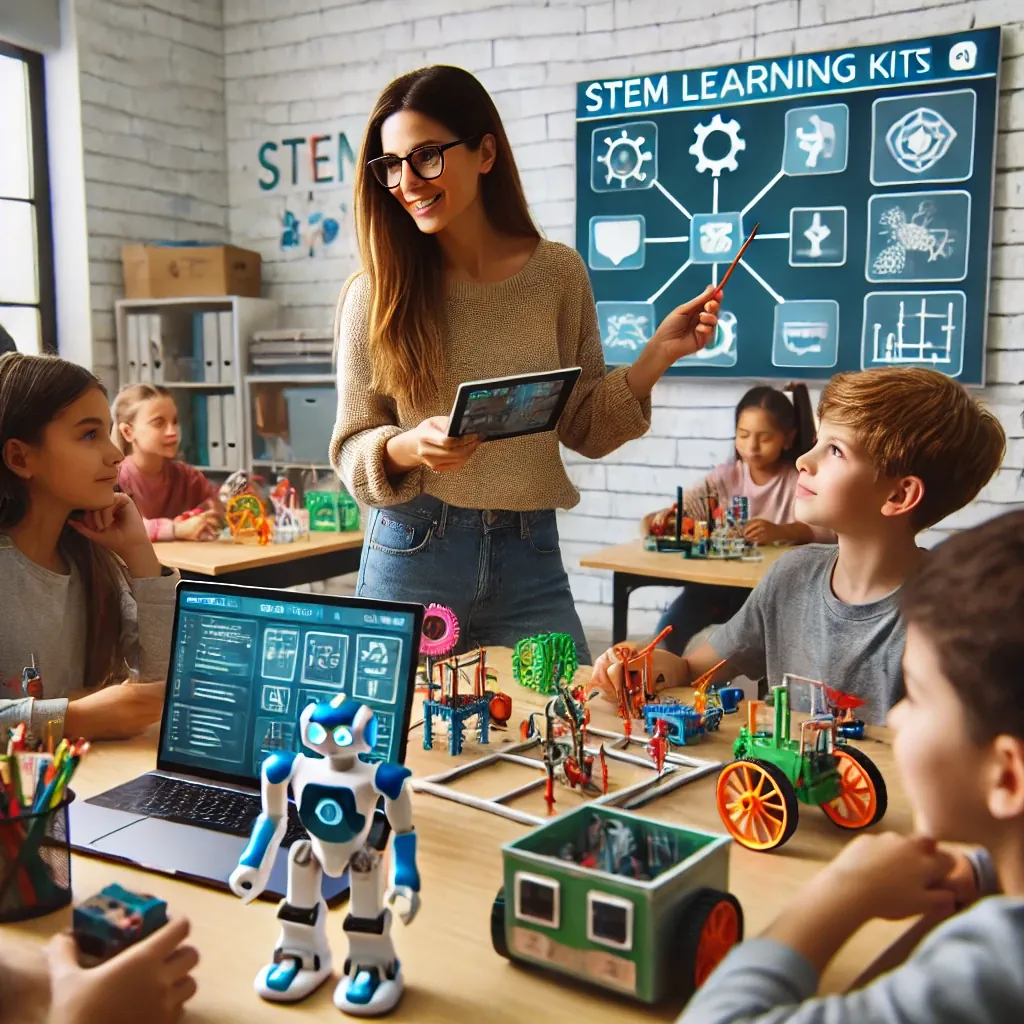
Manipulatives — counting sticks, linking cubes, number balance scales, place-value boards — allow children to touch numbers before abstracting them. A 2013 meta-analysis published in the Journal of Educational Psychology (55 studies, more than 7,000 students) found small-to-moderate gains when math was taught with concrete manipulatives rather than abstract symbols alone — with the strongest effects on retention, and results that depend on how well the teacher guides their use.
In a class of 20 to 25 students, you need at minimum one complete set per pair or trio of children. Bulk purchasing then becomes not only economical but logistically essential. See our article on toys for teaching math for specific suggestions.

Reading and literacy aids
Colored reading rulers (or overlays), syllable cards, phoneme dice, sound charts: these tools support early readers and, in particular, children with dyslexia. A reading ruler, for example, isolates one line at a time visually, reducing the line-skipping that exhausts struggling readers (the tint itself is a matter of comfort: research has not shown that color improves reading in dyslexia).
Attention and behaviour management tools
Learning aids for children with ADHD or anxiety include visual timers (sand timers, time-display boards), illustrated routine charts, positive-reinforcement token systems, and dynamic seating cushions. These tools do not replace clinical interventions, but they create a predictable environment that reduces anxiety and frees up cognitive bandwidth for learning.
Sensory toys and fidget tools
Fidgets, therapy putty, marble mazes, sensory cushions: once associated almost exclusively with ADHD, these tools benefit a much broader spectrum of learners. Research led by Mark Rapport's team found that children with ADHD move more when a task taxes their working memory, and that this movement was linked to better performance for them (not for typically developing children) — Sarver et al., 2015. That has fuelled interest in fidgets, although fidgets themselves have been studied far less and with mixed results.
Key takeaway: the four categories complement each other. A well-equipped classroom combines math manipulatives, reading aids, attention tools, AND sensory toys — not one of these families in isolation.
Choosing tools based on learner needs
Before placing a wholesale order, it is essential to map the actual needs of your student group. The most common learner profiles in Canadian schools:
Students with ADHD
Priority tools are those that externalize organization and support self-regulation: visual timers, task boards, discreet fidgets (rings, bracelets, squeeze tools). Avoid tools that are visually overstimulating — flashing lights, very bright colour combinations — which can amplify distraction rather than reduce it.
Autistic students or those with sensory differences
Prioritize low auditory-stimulation tools (no electronic sounds), predictable textures, and structured sensory exploration: putty, chewable sticks, weighted cushions, tactile mazes. The Montessori approach, with its autonomous work trays, pairs especially well with this learner profile.
Students with dyslexia or reading difficulties
Colored reading rulers, color overlays, sound cards, and phoneme dice form the foundation of support. Pair them with dyslexia-friendly fonts (such as OpenDyslexic on printed worksheets) and adequate classroom lighting.
Students with dyscalculia or math difficulties
Physical manipulatives are irreplaceable: Cuisenaire rods, number strips, abacuses, Dienes blocks (base-10 materials). These tools let children build an understanding of number before moving to abstract symbols.
| Learner profile | Priority tools | Avoid |
|---|---|---|
| ADHD | Visual timer, fidget, routine board | Multi-step games, complex rules |
| Autism / sensory | Putty, tactile sticks, weighted cushions | Electronic sounds, flashing lights |
| Dyslexia | Reading ruler, syllable cards, sound dice | Dense text, small font sizes |
| Dyscalculia | Cuisenaire rods, abacus, base-10 blocks | Premature abstract symbols |
| General learning | Varied manipulatives, educational board games | Passive tools (videos alone) |
Learning aid examples by level and subject
- Early learning and preschool: alphabet and number puzzles, Montessori stacking toys, sensory play kits.
- Math and STEM: counting beads and abacuses, magnetic number sets, STEM experiment kits.
- Reading and language: phonics flashcards, sight-word games, speech therapy tools.
- Special needs and sensory development: weighted lap pads, noise-cancelling headphones, fidget toys for ADHD and autism.
- For teachers: interactive whiteboards, classroom learning posters, behaviour reward charts.
Combining visual, auditory and hands-on aids gives every learner a way in and maximizes engagement.
Why buy wholesale: concrete advantages
Volume purchasing is the norm in the school sector for good reasons. Here are the main advantages:
- Significant savings compared to standard retail prices, depending on volumes and suppliers.
- Material consistency: all students use the same tool, simplifying instruction and directions.
- Replacement stock on hand: sensory tools wear out (putty dries out, reading rulers get scratched). Reserve stock prevents mid-year shortages.
- Single ordering process: one annual order instead of multiple ad hoc purchases reduces administrative load.
- Customization options: some wholesalers allow you to add a school logo or choose institutional colours to make materials easier to identify.
To compare options, browse our wholesale learning aids and special-needs toys, or, for schools and retailers south of the border, our wholesale toys for the USA page.

When you equip 12 classrooms with the same reading rulers, you are looking at an investment of a few hundred dollars — versus several thousand if you buy at retail throughout the year. And most importantly, every child has their tool from day one. — Antoine Robillard, founder of Robiii
How to source your learning aids well
Not all learning aids are created equal. Material quality, safety compliance, and pedagogical relevance vary enormously from one supplier to the next. Here is how to navigate the landscape.
Verify safety certifications
In Canada, toys and teaching tools intended for children must comply with the Canada Consumer Product Safety Act and its Toys Regulations (Health Canada guide). Many suppliers also test to ASTM F963 (U.S.) or EN 71 (Europe) — widely recognized standards, but not a substitute for Canadian requirements. Always request compliance data sheets before finalizing a bulk order.
Assess durability
In a school setting, a manipulative is handled dozens of times a day by dozens of different children. Choose robust materials: ABS plastic, FSC-certified wood, natural rubber. A product's lifespan determines its true cost per use — far more revealing than the purchase price alone.
Test before ordering in volume
Order a trial batch of 5 to 10 units, test them in the classroom for two to four weeks, then adjust your order. This step prevents locking up a budget on materials poorly suited to your real classroom environment.
Choose a supplier with after-sales service
A reliable wholesaler offers order tracking, clear delivery timelines, and a reasonable return or exchange policy. See our article on wholesale educational school supplies for a complete buying guide.
Budget tip: plan your bulk orders in May or June, before the end of the school year. You benefit from the best off-season pricing and receive materials before the September back-to-school rush.
Integrating learning aids in the classroom: practical advice
Having the tools is not enough — you also need to integrate them effectively into the class routine. Here is a structured five-step approach:
- Introduce the tool explicitly — show out loud how it is used, what it is for, and when to take it out. Do not assume children will figure out its educational purpose on their own.
- Create a dedicated storage space — one box per tool type, accessible at children's height, with an illustrated label. Independent put-away is itself a skill worth developing.
- Embed tools in routines, not just in one-off activities. A fidget permanently available on a desk has more impact than a tool pulled out on Friday afternoons.
- Observe and adjust — after two weeks, evaluate which tools are used spontaneously and which stay in the box. The former deserve a larger follow-up order; the latter should be revisited or set aside.
- Involve families — a one-page guide sent home explaining the tools used in class makes it easier for families to continue the support at home.
Watch out: do not introduce more than two or three new tools at once. Too many tools simultaneously creates confusion and reduces student buy-in.
Trends and new teaching resources to watch
The learning aids market is evolving quickly. In 2026, three trends stand out in the orders we process at Robiii.
The strong comeback of low-tech manipulatives
After a decade dominated by tablets and educational apps, teachers are rediscovering the value of physical tools. Research on embodied cognition suggests that touching and manipulating real objects engages the body and senses in ways screens do not, which can support understanding. This trend directly benefits math manipulatives and sensory tools.
Universal inclusion as a standard
More and more schools are adopting the principle of Universal Design for Learning (UDL): designing the classroom so that all students, regardless of their differences, have access to the same tools from the start. In practice, this means fidgets, reading rulers, and visual timers are no longer reserved for students with individualized education plans — they sit on every desk, normalized.
Themed kits for group orders
Rather than selecting each product individually, many educators now opt for themed kits ("Inclusive Reading Kit," "Math Manipulatives Kit," "Self-Regulation Kit") that include a coherent selection of tools at an advantageous price. Robiii offers this type of custom kit for school orders.
For a deeper look at the pedagogical thinking behind these tools, read our article on the Montessori approach to teaching through play — an essential reference for understanding why concrete materials remain irreplaceable.