The Monkey Balance turns abstract math into a hands-on, visual and playful experience. Children put a number piece on one tray of a monkey-shaped scale, then add little monkeys — or other number pieces — to the other tray until the arms are level. They see and feel how numbers balance. With its challenge cards, it is a great way to introduce counting, addition and subtraction without pencils or anxiety.
How much is 4 plus 3? For many children between ages 4 and 7, that question conjures a blank page, a pencil and a knot in the stomach. Numbers stay abstract symbols, disconnected from anything they can touch or see. That is exactly where the Monkey Balance steps in — literally. By placing number pieces and little monkeys on a scale shaped like a monkey, children stop memorizing numbers and start understanding them.
This colourful plastic toy has found its way into countless kindergarten and Grade 1 classrooms, educational therapists' offices and kitchen tables across Canada. This guide walks you through how to use it step by step, what age to introduce it, which activities suit each learning level, and why it is especially valuable for children who need to touch something to understand it.
Overview of the Monkey Balance
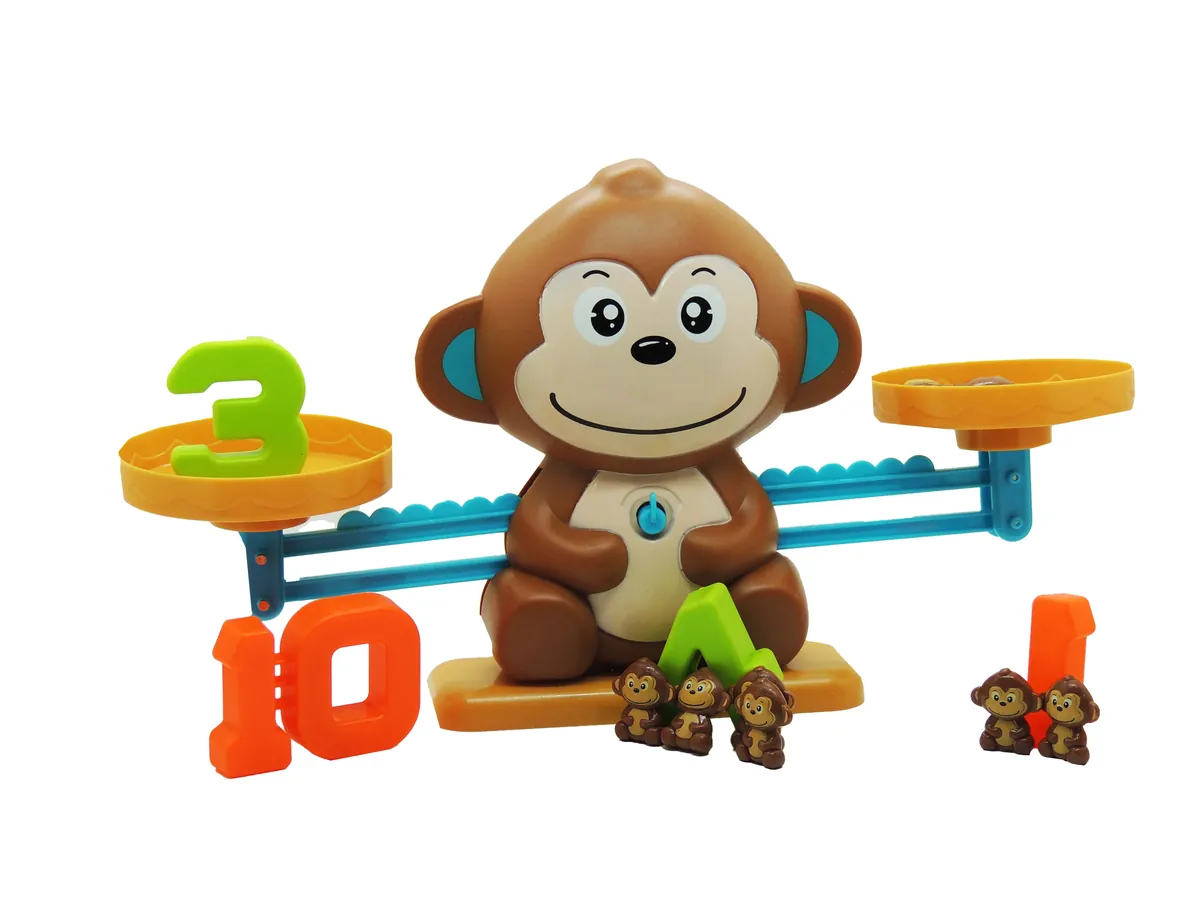
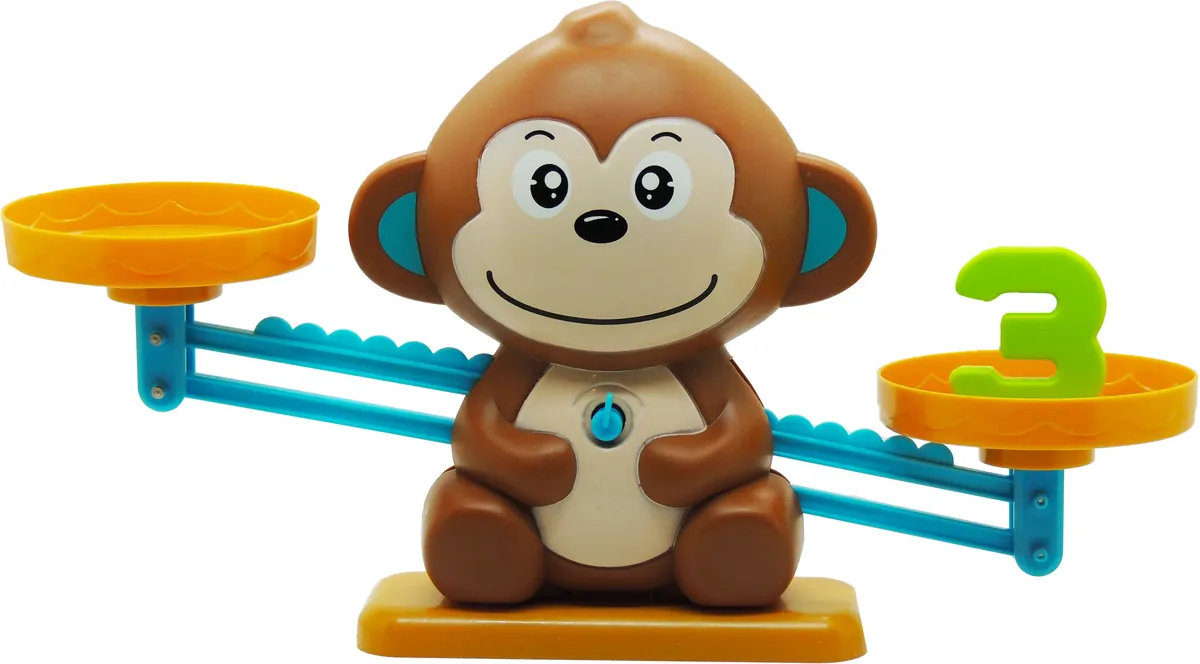
The Monkey Balance is a scale shaped like a smiling monkey. The monkey sits on a base and holds two arms, each with an orange tray. When the trays are empty, the arms are level. As soon as you put a piece on one tray, that side dips — and the child's job is to bring the scale back to level on the other side.
A closer look at the components
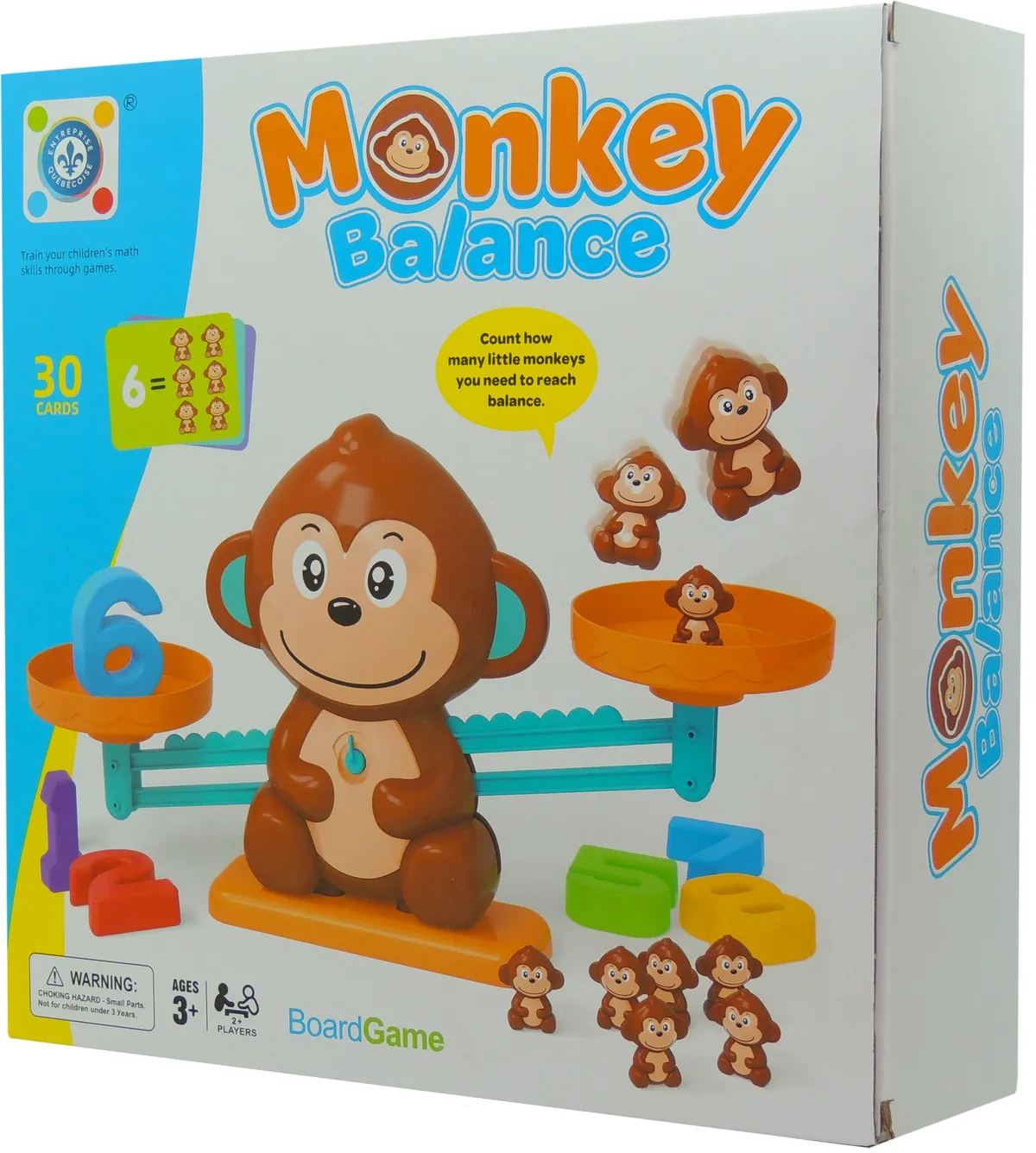
The box contains the monkey scale (body, base, two arms and two trays), a set of colourful number pieces, little monkey figurines and 30 challenge cards. Once the scale is assembled, the pieces are simply placed on the trays.
Here is the key idea: each number piece balances the same number of little monkeys. Put the 6 on one tray and it takes six monkeys on the other tray to bring the arms back to level — which is exactly what the box invites children to do: count how many little monkeys it takes to reach balance. Number pieces can also be combined, so a 2 and a 4 together balance the 6. The scale shows equality or imbalance based on the total on each tray.
Good to know: before playing, check that the empty scale is perfectly level. If it is not, adjust the small blue piece in the middle (see the assembly steps below); otherwise the scale will not give the right answers.
Step-by-step instructions
Here is how to introduce the Monkey Balance to a child trying it for the first time. Go slowly — free exploration is often worth more than a formal demonstration.
- Set the balance on a stable, flat surface and confirm the arms are level when the trays are empty.
- Show the pieces to the child: name the numbers together and invite them to line up the number pieces in order. Then count a few little monkeys together.
- Try the first experiment: put the 3 on the left tray. Ask, "Which way does the balance tip?" Then add little monkeys to the right tray, one at a time, counting out loud, until the arms are level — three monkeys.
- Issue a challenge: "The 5 is on the left. Can you balance it with two number pieces on the right?" The child tries combinations until they land on 1 and 4, or 2 and 3.
- Vary the challenges by level (see the section below) or draw a challenge card. Let the child make up their own questions for you too.
- Tidy up together, counting the monkeys back into the box — one more learning moment.
Assembling the balance
Setting up the Monkey Balance takes less than a minute:
- Take the monkey — the central body of the balance.
- Clip a small tray onto the blue part of one arm; you will hear a little click.
- Do the same on the other side.
- Set the monkey on its base once both arms and trays are installed.
- Level the arms: if they are not even, adjust the small blue piece in the middle until the balance sits perfectly flat.
That's it — the game is set up and ready to play.
Challenge cards and how to play the game
The game also comes with challenge cards in three difficulty levels, so each player can pick the right challenge: purple cards for beginners, green cards for intermediate players and blue cards for experts.
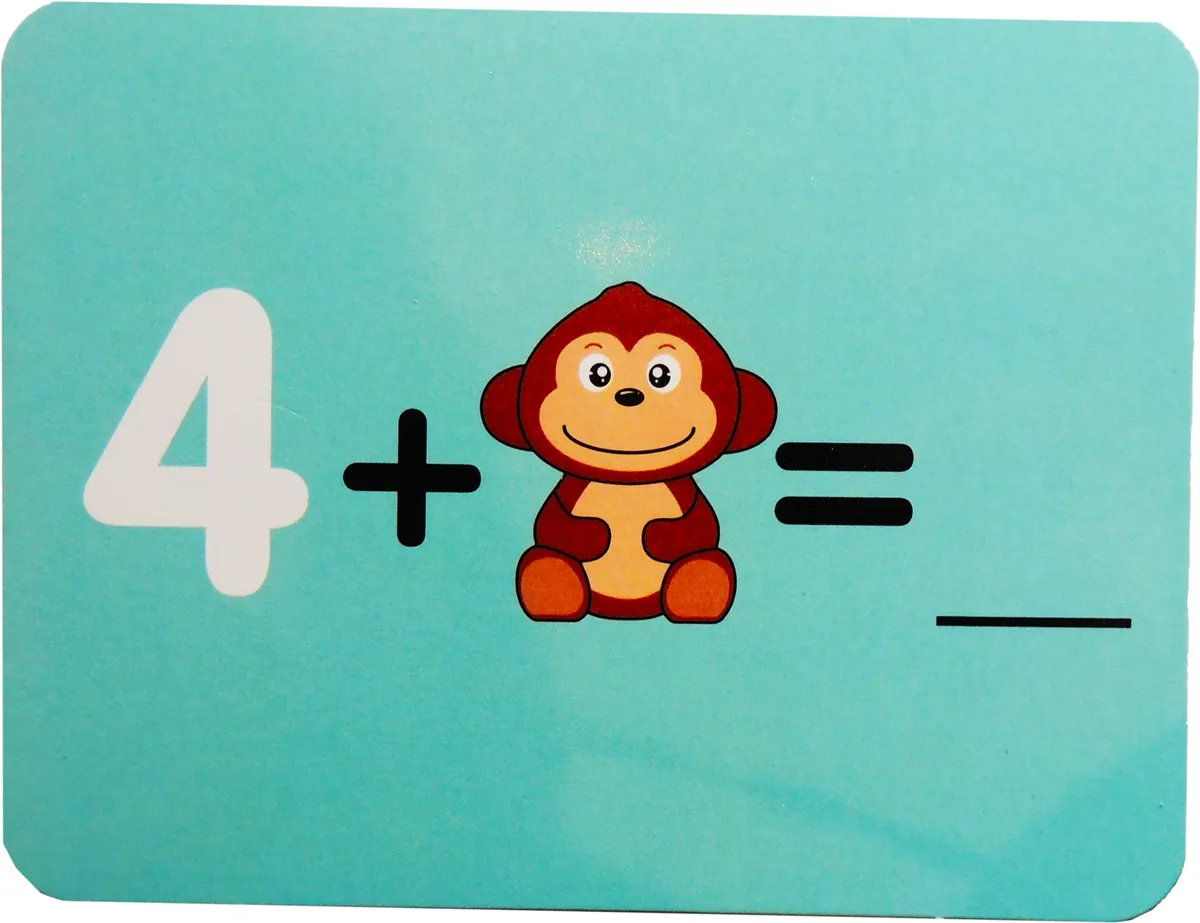
- The youngest player starts by drawing a card.
- They work out the answer to the equation on the card.
- They place the matching number piece or little monkeys on the trays.
- If the answer is right, the balance levels out — instant feedback, no adult needed.
- The goal: be the first player to place all of your pieces on a balanced tray.
The card game is recommended from age 5, and there is no limit on the number of players — simply split the group into two teams.
Activities by learning level
The Monkey Balance scales naturally across several stages of mathematical development. Here is a progression from simplest to most challenging:
Level 1 — Discovery (ages 3–4)
At this age the goal is not yet computation — it is comparison. The child explores the concepts of heavier, lighter and equal. Put a number piece on one tray and a few little monkeys on the other, and observe which side goes down. Name the numbers together. Allow completely free exploration; curiosity does the rest.
Level 2 — Counting and first calculations (ages 5–6)
Introduce simple balance challenges: "Put the 6 on the left. How many little monkeys do you need on the right to balance it?" The child counts the monkeys onto the tray one by one until the arms are level. Then push further: "Can you balance the 6 with two number pieces?" (1 and 5, or 2 and 4). This naturally leads into number decomposition — a foundational skill in kindergarten and Grade 1.
Level 3 — Addition and subtraction (ages 6–8)
The balance becomes a living equation. Draw a card such as "4 + 🐒 = ?": the child puts the 4 and one little monkey on the left tray, then looks for the number piece that levels the scale on the right (the 5). They have just solved an addition without realizing it. For subtraction, reverse the logic: "The 8 is on the left and the 5 is on the right. How many monkeys do you need to add on the right to balance it?" Three — because 8 − 5 = 3.
Classroom tip: prepare laminated challenge cards with blanks to fill in (e.g., ☐ + ☐ = 9) and store them in a bag with the balance. You now have a complete, self-directed math centre activity.
Why the Monkey Balance works so well
Children learn through different sensory channels. Some remember best what they see, others what they hear — but a large majority of young children learn through physical manipulation. This is what educators call kinaesthetic learning.
The Monkey Balance meets that need by making mathematics tangible:
- Children see the imbalance — they do not need to imagine that 4 is greater than 3.
- They touch and place the pieces — muscle memory reinforces cognitive memory.
- They receive immediate feedback — the balance tips or holds, without waiting for adult correction.
- They are playing — positive emotional engagement boosts long-term retention.
These principles sit at the heart of Montessori pedagogy, which places hands-on manipulation at the centre of math learning. The Monkey Balance pairs naturally with a Montessori approach to play, alongside number rods and golden beads.
When a child understands that 3 + 4 = 7 because they felt it with their fingers, they never forget it. Numbers stop being abstract enemies. — The Robiii team
Monkey Balance and children with special needs
Educational therapists and special education teachers have long valued the Monkey Balance for the reasons below:
For children with ADHD
Active manipulation keeps attention where a worksheet loses it. Placing, removing, observing — each action is short and stimulating. A child with ADHD stays engaged because the toy moves and changes with every attempt. For more ideas in this vein, see our guide to toys for teaching math concepts.
For children with dyslexia or writing difficulties
These children typically have no trouble with numbers themselves, but often struggle with their written representation. The Monkey Balance sidesteps this barrier: the child reads the numeral on the number piece, but the activity itself remains physical. Less reading, less writing — more genuine understanding.
For children with math anxiety
Math anxiety is real and widespread. The Monkey Balance takes the pressure off by framing calculation as a balancing game. There is no "right answer on paper" to produce: just a scale that tips or holds. Mistakes become data points, not failures.
| Child profile | Primary benefit | Recommended activity |
|---|---|---|
| Typical learner (ages 3–5) | Discovering quantities | Free exploration, heavy/light |
| Typical learner (ages 5–8) | Addition and decomposition | Balance challenges, card prompts |
| Child with ADHD | Engagement through action | Timed challenges, short rotations |
| Child with dyslexia | Bypassing written text | Verbal challenges, no written cards |
| Math anxiety | Reducing pressure | Free play with no expected outcome |
Using the Monkey Balance in the classroom
In a school setting, the Monkey Balance slots easily into several pedagogical formats. Here are concrete approaches tested in real classrooms:
- Independent math centre: place the balance with a set of laminated challenge cards. Students who finish their work head there independently.
- Partner activity: one student secretly puts a number piece on one tray behind a small screen (a standing book works well), while the other must balance the scale with little monkeys, then guess the hidden number. The mathematical dialogue that follows is rich and natural.
- Explicit instruction: use the balance at the board to illustrate an addition during whole-group instruction. The visual supports every learner profile in the room.
- Individual support: in an educational therapy or resource-room setting, the balance allows reteaching foundational concepts without the failure connotation that written exercises can carry.
The Monkey Balance pairs beautifully with other learning aids and teaching toys available wholesale for schools and educators looking to stock multiple classrooms at once.
Safety note: the box warns that the game contains small parts — the little monkey figurines in particular — that may pose a choking hazard for children under 3. Reserve the game for ages 3 and up, and supervise younger children at all times.
Guiding questions to enrich play
The quality of the questions you ask during play largely determines the depth of the learning. Here are prompts suited to different stages:
- "What do you notice? Which way does the balance tip?"
- "If I take one monkey off, what happens? How do we get it balanced again?"
- "Find two different ways to balance the 7. Are there others?"
- "How many little monkeys does it take to balance the 10?"
- "Can the 6 and the 4 on one side balance the 10 on the other side? Why?"
Open-ended questions like these encourage reasoning and curiosity rather than rote recall. They follow the same spirit as the best practices for teaching math through play.