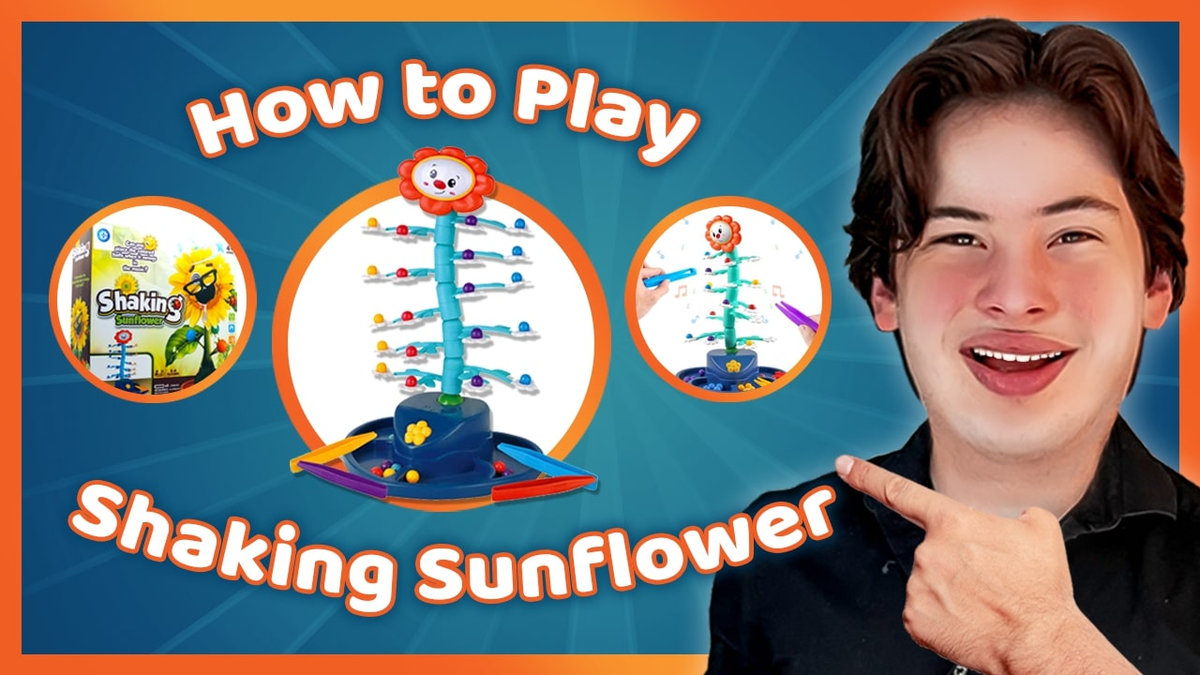
Shaking Sunflower is a battery-powered musical board game for 2 to 4 players aged 4 and up. Press the button and the sunflower sways, wiggles and spins to the music while each player uses a clip to place their coloured balls on its leaves, from the bottom row to the top. If the sunflower shakes your ball off, pick it up and try again. The first player to place all of their balls wins.
Can you place your coloured balls on a sunflower that will not stop dancing? That is the whole challenge of Shaking Sunflower, a musical board game in which a sunflower sways, wiggles and spins to the music while the players race to fill its leaves. It takes a steady hand, a sharp eye and a little luck — and most rounds end in laughter.
This guide explains how to play Shaking Sunflower: what's in the box, how to assemble the sunflower, the basic rules, how to win and four variants to keep game night fresh. You will also find tips for adapting the game to younger players and for using it at home or in the classroom.
What is Shaking Sunflower?
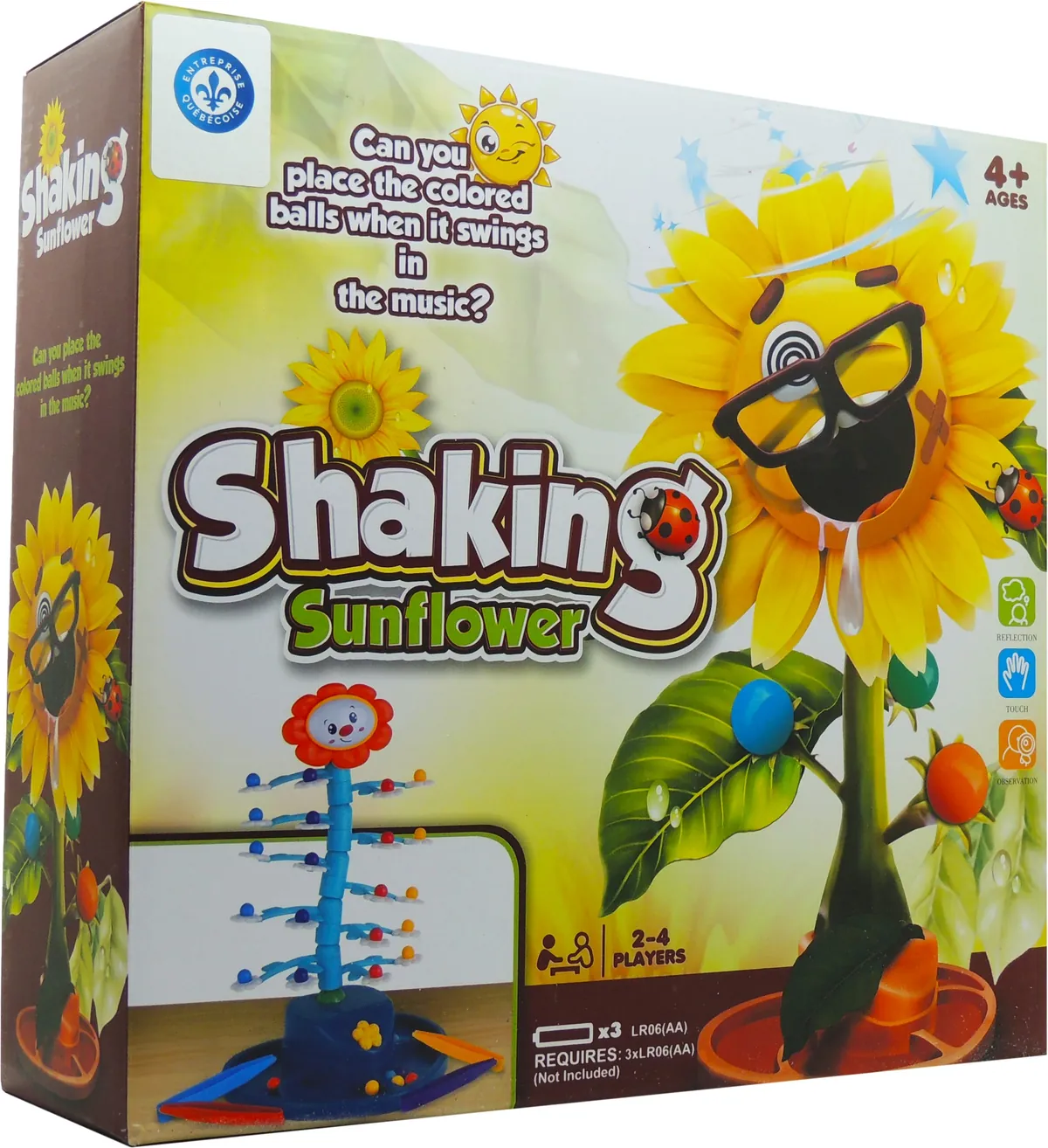
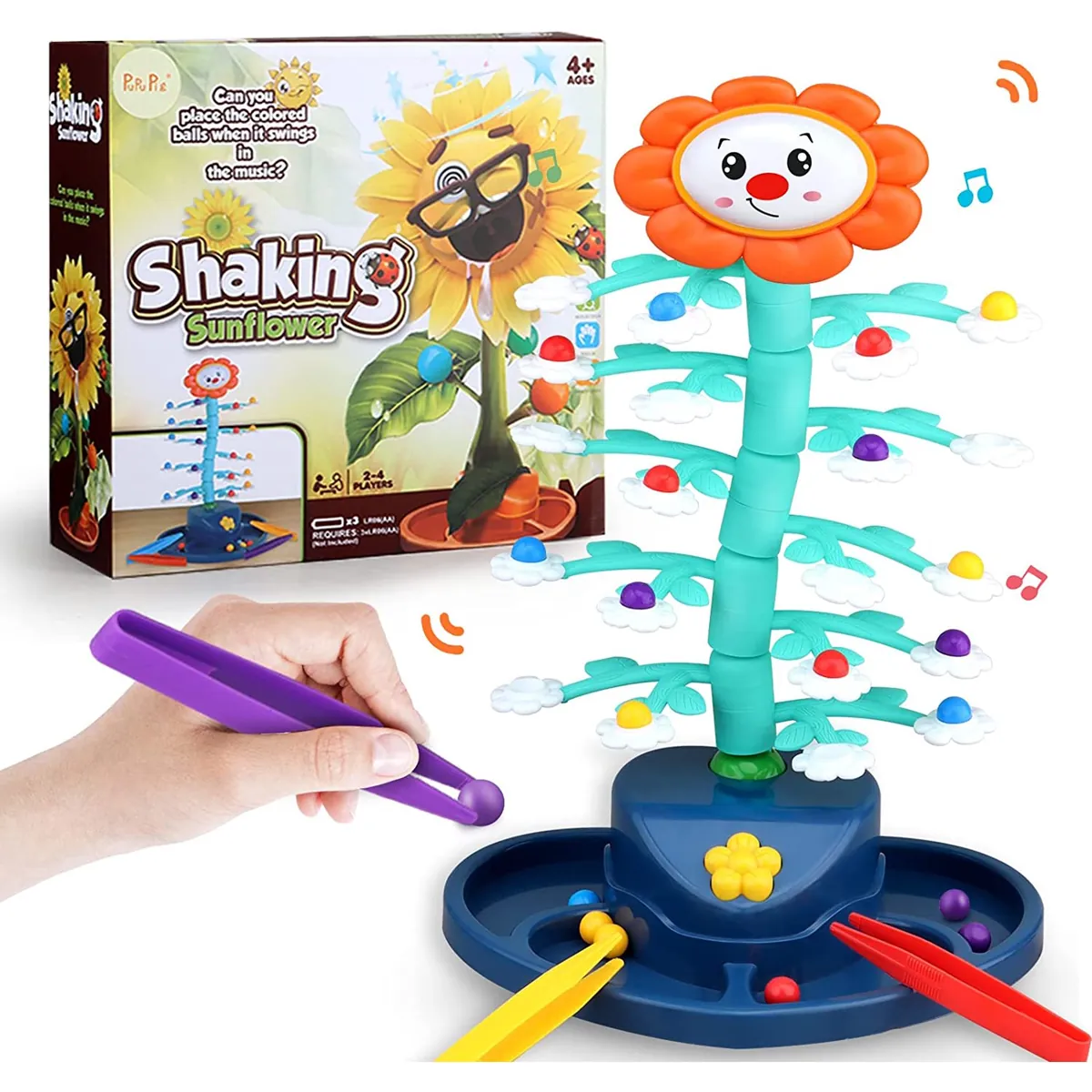
Shaking Sunflower is a tabletop dexterity game. The sunflower stands in a base divided into four sections, one for each player's colour. Its stem is built from stacked segments with leaves, and each leaf ends in a small flower-shaped cup that holds one ball. Once switched on, the sunflower plays music and moves: it sways, shakes and, every now and then, turns a full 360°. Your job is to place your balls on the leaves anyway.
Because players pick up the balls with plastic clips (small tweezers), the game also works the pincer grip, hand-eye coordination and patience. The box highlights three skills: reflection, touch and observation. Like other forms of play, it gives children plenty of practice without ever feeling like an exercise.
Key features
- A musical sunflower that sways, shakes and randomly spins 360°.
- For 2 to 4 players, ages 4 and up.
- 4 plastic clips and 24 coloured balls, sorted by colour in the base.
- One button to start, pause or stop the game.
- Runs on 3 AA (LR06) batteries, not included.
- Several ways to play: a race, a battle, a co-op round against the clock and two dice variants.
How to play Shaking Sunflower: step-by-step instructions
What's in the box
- 1 base
- 1 sunflower
- 4 clips (tweezers)
- 24 coloured balls
Setting up the game
- Install the batteries: the sunflower needs 3 AA (LR06) batteries, which are not included.
- Assemble the sunflower: remove the central axis, attach the five segments of the sunflower's body in order, then cover everything with the top cap to hold it securely.
- Fit the sunflower into its base.
- Sort the balls into the four sections of the base, one colour per section.
- Learn the clip grip: index finger in the middle, thumb on one side and middle finger on the other — a firm hold for picking up the balls.
How to play and how to win
- Start the game by pressing the sunflower's button: it starts to shake and wiggle to the music. Press it again to pause or stop.
- Race to fill the sunflower: each player uses a clip to place their coloured balls on the leaves, from the bottom row up to the top. For an easier version, younger players can use their hands.
- Stay alert: if the sunflower shakes your ball off, pick it up and try again.
- Expect surprises: the sunflower also rotates 360° at random moments.
The first player to secure all of their coloured balls on the sunflower wins!
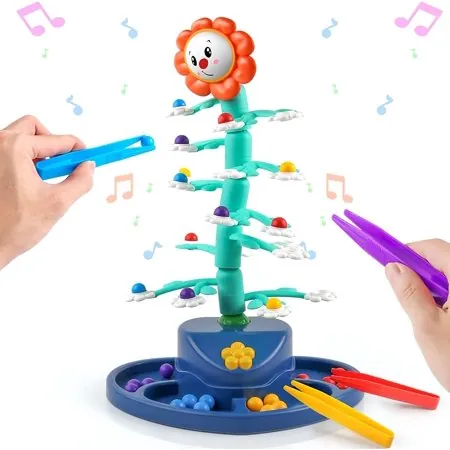
Tip: before the first game, let everyone practise the clip grip while the sunflower is switched off. Once each player can pick up and place a ball on a still leaf, press the button and let the music start.
Game variants
- Battle mode: everyone plays at the same time, and players may use their clips to remove an opponent's balls. The first to place all their balls wins.
- Co-op mode: set a timer (for example, two minutes) and all players work together to place every ball before time runs out.
- Roll & place: on your turn, roll a die to find out how many attempts you get to place your balls. The first to place them all wins.
- Dice actions: the die decides how you play — 1: use your fingers; 2: use the clip with your non-dominant hand; 3: remove an opponent's ball; 4: switch off the sunflower's movement; 5: normal turn; 6: pass your turn.
Adapt the rules freely for younger players so the game stays fun at every skill level.
Who is Shaking Sunflower for?
The box recommends Shaking Sunflower for children aged 4 and up, with 2 to 4 players. It works especially well for:
Families and game nights
The rules take a minute to explain, rounds are short and adults can play too. To even out the chances between an adult and a young child, use the dice actions — an adult who rolls a 2 has to play with their non-dominant hand.
Young children building fine motor skills
Picking up a small ball with a clip and placing it on a leaf that keeps moving calls for a precise pincer grip and good hand-eye coordination. Start the youngest players with their hands, then introduce the clips once they feel confident.
Children with ADHD
The game gives quick, clear feedback: the ball stays or it falls. Short rounds, constant movement and the co-op mode against a timer suit children who need action and a clear goal. Keep the rounds brief and stop while everyone is still having fun.
Children who are sensitive to noise or movement
Shaking Sunflower plays music and moves on its own. If that is too much for a child, press the button to pause, or play with the dice actions, where a 4 switches off the sunflower's movement. You can then bring the motion back gradually as the child gets used to the game.
Activity ideas at home and in class
Beyond the classic race, Shaking Sunflower adapts to many moments of the day.
| Context | How to play | What it works on |
|---|---|---|
| Family game night | Classic race, 2 to 4 players | Turn-taking and fair play |
| Adult and young child | Dice actions to balance the challenge | A fair game for every age |
| Classroom or daycare | Co-op mode with a two-minute timer | Cooperation and communication |
| Fine motor practice | Place balls with the clip, sunflower switched off at first | Pincer grip and precision |
| Youngest players | Sort the 24 balls by colour into the base | Colours, sorting and counting |
| Quick brain break | One short round between two tasks | Moving, laughing and refocusing |
In a school setting, Shaking Sunflower fits naturally into a game centre alongside other educational toys for the classroom.
With its moving sunflower and its different ways to play, no two games of Shaking Sunflower are ever the same. — The Robiii team
Tips for parents and educators
A few simple habits keep the game fun and accessible for every player.
Start easy
For a first game, play with hands rather than clips, or pause the sunflower while children learn where the balls go. Add the clips and the movement once everyone is comfortable.
Use the variants to level the field
The dice actions are a great equaliser: fingers for one player, the non-dominant hand for another, a skipped turn for the leader. Everyone stays in the game until the end.
Treat falling balls as part of the game
The rules are clear: if the sunflower shakes your ball off, you pick it up and start again. Say it out loud before the game starts, so a falling ball becomes a funny moment rather than a frustration.
Note: if a child finds the clips very hard to use, let them play with their hands — the rules allow it for an easier version. Ongoing difficulties with fine motor tasks are worth discussing with an occupational therapist.
Keep rounds short
A two-minute co-op round or a single race is often enough. Ending on a high note makes children want to play again.
Care, batteries and safety
A few simple precautions keep the game working well for a long time.
- Batteries: the sunflower runs on 3 AA (LR06) batteries, which are not included. If the game will be stored for a while, remove the batteries.
- Assembly: if the sunflower wobbles too much or a segment comes loose, check that the five segments are attached in order and that the top cap is firmly in place.
- Storage: keep the 24 balls and 4 clips in the box with the sunflower, and count the balls after each game so none go missing.
- Cleaning: wipe the pieces with a slightly damp cloth. Never put the sunflower in water: it contains the batteries and the music and motion mechanism.
Warning: the game contains small balls. It is recommended for ages 4 and up; keep the balls out of reach of younger children who put objects in their mouths.
What Shaking Sunflower helps develop
Behind the laughter, every round asks children to use several skills at once:
Fine motor skills and the pincer grip
Opening and closing a clip, holding a small ball and releasing it at the right spot: these are the same precise finger movements children later use to hold a pencil or button a coat.
Observation and anticipation
The sunflower moves to the music. Players learn to watch its rhythm and wait for the right moment before placing a ball — a playful way to practise attention and patience.
Frustration tolerance and social skills
A ball falls, you pick it up and try again. Taking turns, winning and losing, and working as a team in co-op mode are all part of the game.
To learn more about why play matters so much, read our article on the benefits of play for children, or browse our store for other games and toys that help children learn while having fun.