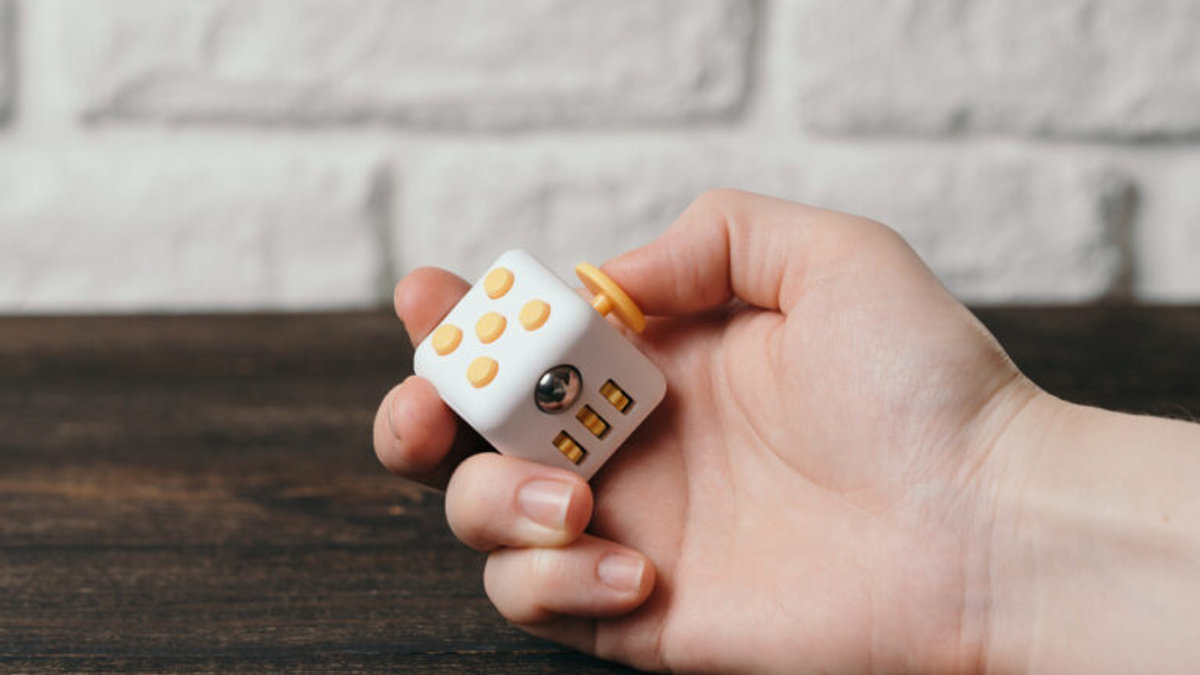

Fidgeting — moving your hands, tapping your fingers, spinning a pen — is not a failure of attention: it is often a sign the brain is working. Research suggests that, for some people — especially those with ADHD — this low-intensity movement can help the brain keep the activation level it needs to process information. Far from being a distraction, fidgeting can be a genuine focus tool in its own right.
We have all been there: an endless meeting, a droning lecture, and our hands — almost without thinking — start doodling, twisting a pen or fiddling with an elastic band. For a long time this behaviour was seen as a sign of inattention or rudeness. Yet neuroscience researchers had been building a very different — and far more nuanced — picture for years.
What science reveals today is that fidgeting is a natural neurological behaviour, particularly valuable for people living with ADHD, anxiety or an atypical sensory profile. Understanding why this need exists — and how to meet it intelligently — can transform the relationship a child, a teenager or an adult has with focus and stress management.
What exactly is fidgeting?
Fidgeting refers to any low-amplitude motor activity performed in a semi-automatic way during a cognitive effort: tapping fingers, rolling a pen between palms, rocking on a chair, fiddling with an object or spinning a ring on a finger.
This behaviour differs from unproductive restlessness in that it is repetitive, rhythmic and unobtrusive — it requires no conscious attention and does not interrupt the main task. That is precisely what makes it an interesting phenomenon: it happens in parallel with cognition, not in place of it.
The most common forms of fidgeting
- Tapping fingers or feet on a surface
- Spinning a pen, ring or object between fingers
- Chewing a pen cap or the collar of a shirt
- Rocking on a chair or bouncing a leg
- Manipulating a fidget cube, therapy putty or a spinning ring
- Doodling in the margins of notes
What science says about fidgeting
Scientific interest in fidgeting grew sharply in the 2000s alongside advances in cognitive neuroscience. Here is what researchers have uncovered over the years.
The brain needs an optimal activation level
The Yerkes-Dodson law — formulated in 1908 from animal experiments and still widely used as a model — holds that there is an optimal arousal zone for cognitive performance: too little stimulation and the mind wanders; too much and it freezes in anxiety. Fidgeting may act as a natural regulator: by adding mild sensorimotor stimulation, it can help keep arousal in the range that favours concentration.
Observed benefits in children with ADHD
A study led by Dustin Sarver and colleagues at the University of Central Florida (2015) measured the movement of children with ADHD during working memory tasks. The finding: those who moved more during the task tended to score higher — a link not seen in children without ADHD. The study measured natural movement (with sensors), not fidget toys.
"The message isn't 'Let them run around the room,' but you need to be able to facilitate their movement so they can maintain the level of alertness necessary for cognitive activities." — Dr. Mark Rapport, co-author, University of Central Florida (UCF, 2015)
Doodling improves memory
A study by Jackie Andrade published in Applied Cognitive Psychology (2009) found that participants who doodled while listening to a monotonous phone message recalled 29% more information than those who did not. The author's explanation: the light activity absorbed just enough spare attention to stop the mind drifting into daydreaming. It was a small study (40 adults), and later research has been mixed.
Note: fidgeting is not a universal solution. Its benefit depends on the type of task — it helps more with listening or memory tasks than with tasks that themselves require fine hand coordination.
Fidgeting, ADHD and anxiety: a strong connection
The urge to fidget is universal, but it is noticeably more intense in certain populations. Understanding these differences helps tailor tools and environments more effectively.
ADHD: a neurological need for stimulation
One leading explanation is that in ADHD, brain networks involving the prefrontal cortex — responsible for planning, impulse control and working memory — tend to be under-aroused. To compensate for this under-arousal, the brain may seek extra stimulation. Fidgeting therefore represents a spontaneous self-regulation strategy: the body finds on its own the fuel the brain needs to stay online.
This is why suppressing fidgeting in a child with ADHD — by demanding they sit perfectly still — can backfire: the effort of holding still can use up attention, and frustration may rise. By contrast, offering a discreet, accepted sensory outlet often helps the child stay on task longer. Learn more in our article on how fidget toys help people with ADHD.
Anxiety and stress: a safety fidget
In anxious individuals, fidgeting plays a slightly different role: it serves as an emotional regulator. Repeating a familiar gesture, turning a ring, kneading putty — these actions can be soothing and help take the edge off stress. It is no coincidence that humans rub their hands, play with their hair or drum their fingers whenever a situation becomes stressful.
These small movements have side benefits too. Fidgeting keeps blood circulating — helpful for anyone who spends most of the day sitting — and by releasing the stress that builds up over the day, it may make it easier to unwind in the evening.

Tip for parents: if your child fidgets compulsively or in a self-harming way (nails bitten to bleeding, hair pulled out), consult an occupational therapist. They can propose a tailored sensory diet and safe substitution tools.
The best tools to channel fidgeting
Not all fidgets are equal. The right tool depends on age, context (home or classroom) and the person's sensory profile. Here is a comparison of the most popular options:
| Tool | Best for | Advantages | Context |
|---|---|---|---|
| Fidget cube / Fidget pad | Children 5 yrs + | Multiple stimuli, compact | Classroom, home, transit |
| Fidget spinner ring | Teens and adults | Discreet, stylish, silent | Meetings, work, school |
| Therapy putty | 4 yrs + | Sensory, silent, calming | Home, speech therapy, office |
| Chewable tool | Children with oral stimulation needs | Safe, reduces chewing on clothing | Classroom, home |
| Chair elastic band | 5–12 yrs | Allows foot movement | Classroom only |
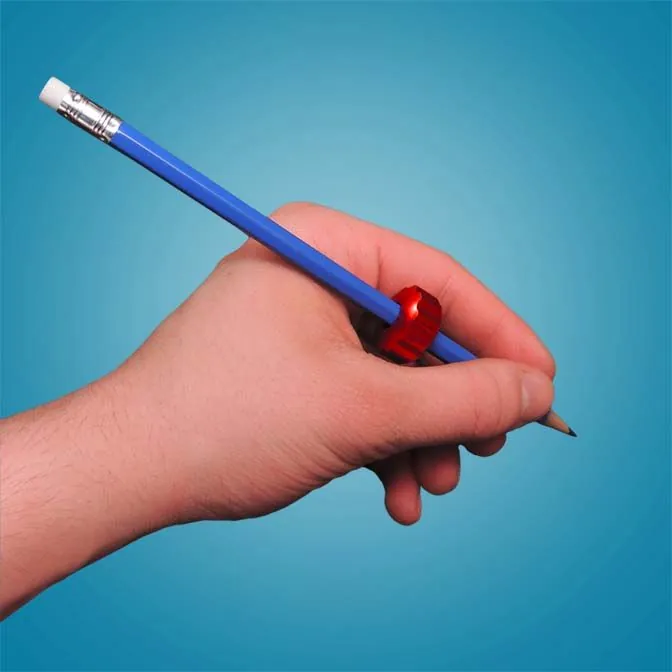
Not sure where to start? The Rolliii, Robiii's signature fidget, slides onto a pencil and spins under the fingers while the child writes — a discreet way to keep hands busy without leaving the task.

Fidgeting at school: how to get teachers on board
One of the biggest challenges for families is getting the teacher or school administration to agree to let a child use a fidget tool in class. Here is a three-step approach that has worked well.

- Present the research. Bring a one-page summary of one or two studies (Sarver 2015, Andrade 2009) and explain the neurological mechanism in plain language. Teachers respond well to concrete data.
- Propose a structured trial. Suggest a two-week period with a silent, visually unobtrusive tool (putty in a pocket, spinning ring). Offer to share the child's observations at the end of the trial.
- Choose the right tool. A spinner with spinning blades that captures the attention of the whole row is counterproductive. A discreet, silent fidget is far easier for the school team to accept.
Also see our article on ADHD strategies in the classroom for more accommodation ideas and ways to collaborate with the school.
Fidgeting in adults: a taboo that is fading
The workplace has long treated any involuntary movement as a sign of unprofessionalism. That perception is changing — and not a moment too soon. Leading companies have begun integrating movement-friendly spaces into their offices, recognizing that some employees think more effectively when their hands are occupied.
Adults who grew up without an ADHD diagnosis but who always needed to move to concentrate are finally finding a language to describe what they experienced. Far from being a flaw, their fidgeting is simply a different information-processing style — and an equally valid one. To understand where the need comes from, the article on the meaning of fidgeting offers valuable complementary insight.
- In meetings, a fidget spinner ring or a discreet stress ball can maintain attention without attracting stares.
- At the desk, therapy putty kept in a drawer is on hand for any moment of stress or cognitive fatigue.
- During deep-work sessions, slow walking on a desk treadmill or a gentle rocking chair can help some people stay focused.
Explore our fidget toys and sensory tools available for all ages — children and adults alike.