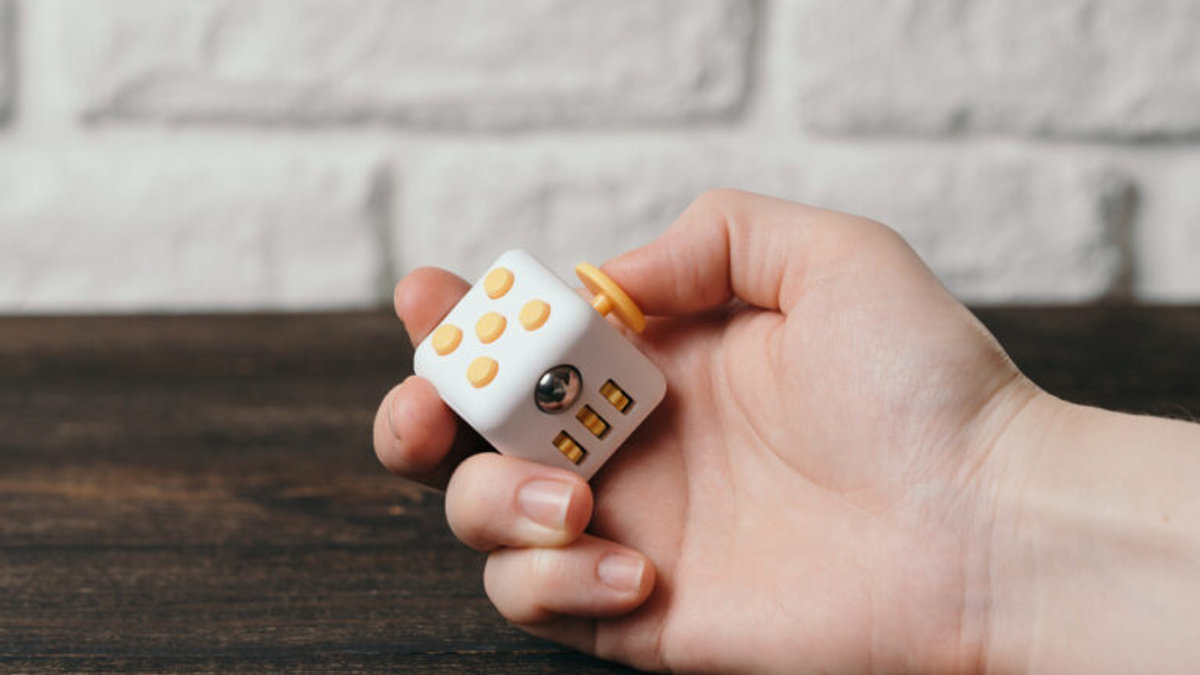
A fidget pad is a small sensory tool designed to be held in one hand, packed with buttons, rollers and varied textures. For a child with ADHD, it provides the motor stimulation their brain craves in order to stay calm and focused — in class, at home or on the go — without disturbing anyone around them.
Does your child squirm in their seat, tap their fingers on the desk, or refuse to sit still the moment they have to stay put? That's not defiance — it's an ADHD brain searching for the sensory input it needs to wake up and pay attention. Movement is not the enemy of focus. In the right form, it can be focus's best friend.
That's where the fidget pad comes in. Small, discreet, silent — it keeps the hands occupied while the mind does the work. Many teachers, occupational therapists and parents across Canada use it as an everyday tool for supporting children with ADHD. Here is why it works, how to use it day-to-day, and how to pick the right model for your child.
What is a fidget pad?
A fidget pad — sometimes called a sensory pad or stress-relief tablet — is a compact device, usually palm-sized, that packs about ten interactive features onto a single surface: push buttons, thumb rollers, a joystick, slide switches, rolling beads, textured zones, mini gears and more. Each element meets a different sensory need: pressure, pull, rotation, texture.
The concept is straightforward: give the hands a light, self-directed activity so the brain can direct all its energy toward the main task — listening to a lesson, reading a passage, waiting for one's turn. Unlike spinners or fidget cubes limited to a single gesture, the pad offers enough variety to stay interesting over weeks without requiring conscious attention.
Models exist for children, teens and adults. The Robiii Fidget Pad is built specifically for school-age kids: buttons sized for small fingers, materials that withstand hours of daily use, and a low-profile design that goes unnoticed on a classroom desk.
Available in three colours — red, green and yellow — it is one of the most popular sensory tools among teachers, occupational therapists and parents of children with ADHD in Canada.
Why the fidget pad is especially helpful for ADHD
Attention-deficit/hyperactivity disorder (ADHD) is characterized, among other things, by difficulty sustaining attention on low-stimulation tasks, a tendency toward motor hyperactivity, and a constant search for sensory input. One influential view is that the ADHD brain does not lack attention capacity so much as the arousal needed to deploy it.
ADHD affects an estimated 5 to 9% of children in Canada (CADDAC) — in practice, one or two students in almost every classroom.
Research supports part of this picture: studies that measured children's movement found that children with ADHD tended to perform better on working-memory and attention tasks when they moved more (Sarver et al., 2015; Hartanto et al., 2016) — a link not seen in children without ADHD. Fidget tools themselves have been studied less, and results are mixed, but for many children moving the hands seems to feed attention rather than scatter it.
Movement as a sensory regulator
Pediatric occupational therapy has long recognized the importance of proprioceptive stimulation — the pressure and resistance felt by joints and muscles. Pressing a button, turning a roller or sliding a switch sends a proprioceptive signal to the brain that helps it self-regulate. It is the same principle as squeezing a stress ball, but richer and more targeted. A fidget pad sits in that sweet spot between effective stimulation and classroom discretion.
Fewer disruptive behaviours
A child with ADHD who has no sensory outlet will find one on their own: tapping their feet, chewing their pencil, chatting with a neighbour, getting up without permission. By offering a concentrated alternative that fits in the palm of a hand, the fidget pad can reduce these side behaviours — a win for the child and for everyone else in the room.
Good to know: a fidget pad is not a treatment for ADHD. It works best as part of a broader approach that may include medication, occupational therapy, educational support and school accommodations. Talk to the professionals working with your child to integrate this tool in the most effective way.
Robiii product
Fidget Pad
Compact sensory tablet with over 10 interactive features (buttons, rollers, joystick, sliders). Built for school-age children, silent and durable. Perfect for channelling energy in class or at home.
$9.99 CAD · View in store →
Ordering the Fidget Pad wholesale
Teachers, occupational therapists, parents and retailers all use the Robiii Fidget Pad — and for stores it is a fast-turning item with an excellent retail margin. Wholesale pricing is available to registered retailers, with a $200 minimum order and shipping within 3 business days from Blainville, Quebec. Larger orders unlock partner perks: free shipping from $599 (Starter), a 2% discount from $999 (Growth) and a 3% discount from $3,000 (Elite), with payment terms set per account. See the Fidget Pad or explore the wholesale program.
How to use the fidget pad day-to-day
A fidget pad dropped on a desk without any guidance can become a distraction rather than a focus tool. Here is how to integrate it effectively into your child's routine:
- Introduce it at home first, in a relaxed setting, so the child can explore all the features without pressure. They will learn to use it discreetly before taking it to school.
- Set a clear rule: the fidget pad stays in the hand, ideally under the desk, and is not waved around or shown off. This prevents distractions and requests from classmates.
- Link it to specific tasks: lectures, silent reading, homework — the moments when sitting still and staying attentive is hardest.
- Do not use it during active play or activities that need both hands: the pad should stay associated with focus time.
- Put it away in the evening and avoid letting it become a permanent comfort object — the goal is to need it less over time, not more.
Tip: if the teacher is hesitant, share our article on ADHD strategies for teachers and parents. A note from an occupational therapist or family doctor often makes all the difference in getting school buy-in.
How to choose the right fidget pad
Not all fidget pads are created equal. Before buying, here are the criteria that matter most:
| Criterion | What to look for | Why it matters |
|---|---|---|
| Noise level | Silent or very quiet | Avoids distracting classmates and teachers |
| Size | Compact, fits a child's palm | Makes it easy to use discreetly and carry |
| Durability | Solid materials, firmly attached buttons | Withstands repeated handling for hours a day |
| Variety | 6 to 12 different features | Maintains interest over several weeks |
| Textures | Smooth to semi-textured surfaces | Suitable for most sensory profiles |
Always involve the child in the choice: some prefer firm buttons that require pressure, others like smooth rollers that spin freely. If your child has tactile hypersensitivities, avoid rough surfaces and stick to smooth materials. When in doubt, check with your occupational therapist.
A great fidget pad is one the child forgets they're holding — because it feels so natural that the hands take care of themselves while the mind focuses on something else. — The Robiii team
Fidget pad at school and at home: real-life scenarios
To better picture how this tool fits into everyday life, here are a few real situations where a fidget pad makes a noticeable difference:
In class during a lesson
The teacher is introducing a new concept. Your child starts fidgeting, staring out the window, whispering to a neighbour. With a fidget pad in hand, they can gently roll the thumb roller or press a button — that automatic, silent movement is just enough to keep their arousal level high enough to follow along. Some teachers who have tried it tell us they need to step in less often.
During homework time at home
The homework stretch is often the tensest part of the day: the child has spent all their energy holding themselves together in class, leaving few resources for more concentrated effort. A fidget pad beside them — or in the non-dominant hand — helps them stay seated longer without shutting down. Many families tell us homework time becomes shorter and calmer with the pad — although every child is different.
On the go or in waiting rooms
Line-ups, car rides, medical appointments — any situation where the child must wait without stimulation — are genuinely painful for an ADHD brain. The fidget pad becomes a discreet, portable crisis-prevention tool. Unlike screens, it does not create dependency and does not prevent conversation.
Fidget pad versus other fidget tools: which to pick?
There are many fidget toys on the market today. How does the fidget pad stack up?
- Fidget spinner: a single repetitive motion (spinning). Effective short-term, but loses interest quickly and can become a visual distraction for nearby students.
- Fidget cube: several features spread over 6 faces. Good variety, but less compact and sometimes noisy (clicking sounds can bother others).
- Fidget ring: extremely discreet, worn on a finger. Less stimulation than a pad, but ideal for formal settings or older teens.
- Therapy putty: excellent for fine motor skills and decompression. Messier and less practical for classrooms. Learn more in our therapy putty guide.
- Fidget pad: the best balance of stimulation variety, discretion, durability and school practicality. Our recommended first choice for school-age children with ADHD.
The good news: these tools are complementary. A child can easily use a fidget pad in class, a fidget ring at a restaurant, and therapy putty during OT sessions. The key is understanding how fidget toys help with ADHD so you can make informed choices for your child's specific needs.
Practical tips for parents
Ready to bring a fidget pad into your child's life in a sustainable, stress-free way? Here are the most common mistakes to avoid and the best practices to adopt.
- Do not present it as a "toy" — even if it looks like one. Try: "This is a tool to help your brain listen better."
- Talk to the teacher first, before sending it to school. A heads-up prevents misunderstandings and makes adult buy-in much easier.
- Have a Plan B: if the teacher says no, speak with the school's resource teacher. An individualized education plan (IEP) can include fidget tools as a formal accommodation.
- Track the effect over a few weeks. Is the child calmer? Less disruptive? Finishing homework faster? Keep short notes to share with the professionals supporting them.
- Pair it with other strategies: stress management, clear routines and regular physical activity remain essential pillars for children with ADHD. The fidget pad works best as one piece of a thoughtful puzzle.