Therapy putty is a kneading compound designed to strengthen fine motor skills and ease stress. It comes in several resistance levels — from very soft to extra firm — and the right choice depends on the user's age, hand strength and goal: rehabilitation, focus or anxiety management.
Have you ever watched an occupational therapist pull out a small ball of coloured putty and ask a child to squeeze it, stretch it or roll it into tiny beads? That was therapy putty — a discreet, affordable and surprisingly powerful tool. Used in rehabilitation clinics for decades, it has long since made its way out of the medical office and into classrooms, senior residences and the desks of stressed-out adults everywhere.
But with so many resistances on the market — soft, light, medium, firm, extra-firm — how do you find the right one? This guide gives you everything you need to choose the best therapy putty for each user, set clear goals and get the most out of every session.
What is therapy putty?
Therapy putty is a viscoelastic compound formulated specifically for hand, wrist and finger rehabilitation exercises. Unlike standard modelling clay, it does not dry out in air, maintains a consistent texture over time and delivers reproducible resistance from session to session.
Its key properties include:
- Calibrated resistance: each colour corresponds to a precise resistance level, making it possible to progress in a controlled, measurable way.
- Pleasant texture: tacky enough to engage the fingers during exercises without staining surfaces or leaving residue.
- Versatility: used in physical rehabilitation, paediatric occupational therapy, stress management and as a sensory tool for children with special needs.
- Durability: properly stored, a single container lasts months or even years.
Good to know: therapy putty is not a substitute for professional occupational therapy. For specific rehabilitation goals — following an injury, surgery or as part of a developmental programme — consult an occupational therapist who can tailor the protocol to the individual.
Resistance levels: finding your way around
Most therapy putty manufacturers use a standardised colour code that runs from softest to firmest. Here is the reference chart:
| Colour | Resistance | Ideal profile | Example uses |
|---|---|---|---|
| White or beige | Ultra-soft | Post-surgery, seniors, very young children | Gentle stretches, early rehabilitation |
| Yellow | Soft | Children from age 3, weakened hands, mild arthritis | Pinching, bead-rolling, finger stretching |
| Red | Light to medium | School-age children, beginner adults | Squeezing, pinching, rolling |
| Green | Medium | Teens, adults for general conditioning | Strength exercises, wrist work |
| Blue | Firm | Adults with a good strength baseline | Advanced strengthening, sports recovery |
| Black or grey | Extra-firm | Athletes, manual workers | Maximum force, muscular endurance |
Robiii's own therapy putty comes in four resistances: yellow (extra-soft) for toddlers and people just starting rehabilitation, red (soft) for children aged 5 to 8, green (classic), the standard level recommended for working on pencil grip, and blue (firm) for preteens, teens and adults.
Progression tip: when you can complete all your usual exercises without fatigue after two to four weeks of regular practice, that's your cue to move up one resistance level. Don't rush — gradual progression prevents injury.
Choosing the right putty by user profile
The best therapy putty is the one that suits the person using it, not the therapist or the parent watching. Here is how to match the resistance to four main user groups.
Young children (ages 3–7)
Fine motor skills are still developing at this age. Yellow (soft) resistance is almost always the right call. Sessions should last no more than 5 minutes, and exercises need to feel like games: "Make a snake," "How many beads can you roll in 2 minutes?" or "Hide the coin inside." Keep it playful and pressure-free.
For children with autism or ADHD, therapy putty also works as a sensory tool that channels hand energy, frees attention and reduces restlessness. The slightly tacky texture and infinite malleability meet the need for proprioceptive stimulation without disrupting the classroom.
Older children and teens (ages 8–17)
Red to green resistance suits most healthy young people who want to strengthen their grip, improve their handwriting or manage stress. For athletic teens or those who play a musical instrument, green or even blue may be appropriate once a baseline has been established.
Adults in maintenance or rehabilitation
Adults using putty to prevent musculoskeletal issues — carpal tunnel syndrome, tendinitis — typically start with red or green. Post-surgery or post-fracture, always restart with the softest resistance available and follow the protocol set by your healthcare professional. Build back slowly.
Seniors
Maintaining grip strength is critical for independence and fall prevention. Yellow to red resistances are ideal for regular maintenance without the risk of joint strain. That is a good reason to keep a container of putty within reach — ideally as part of a broader strength and balance routine recommended by a health professional.
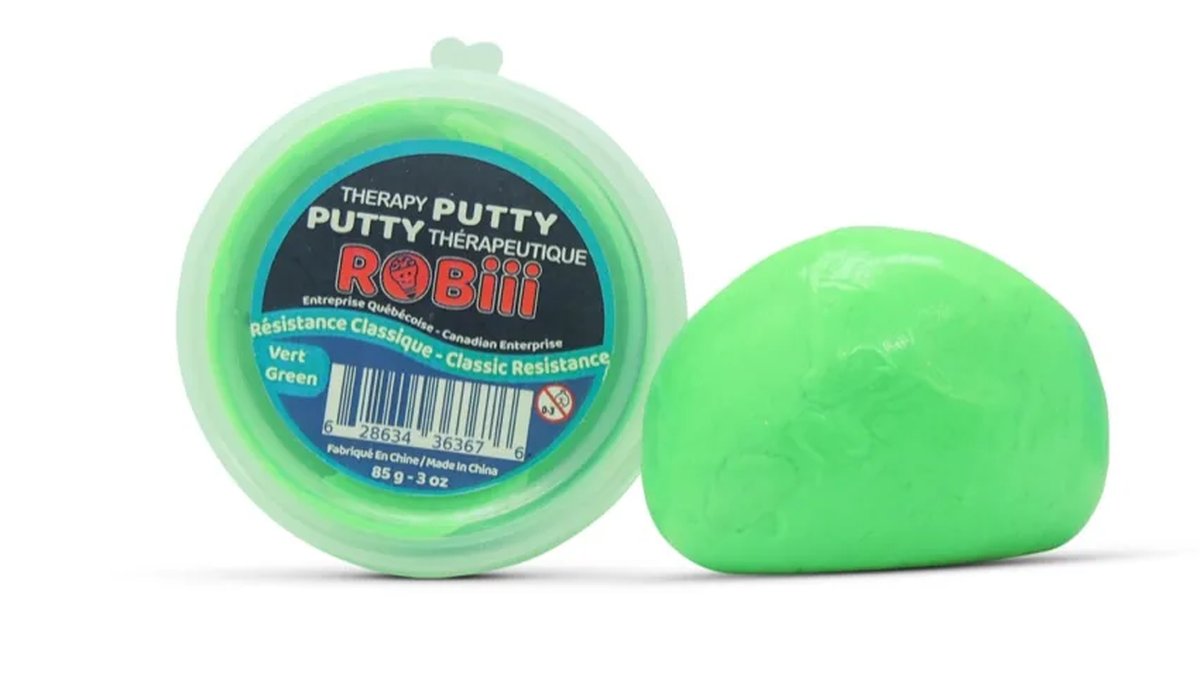
Robiii product
Therapy Putty
Viscoelastic therapy putty available in multiple resistance levels. Perfect for building fine motor skills, grip strength and wrist mobility — at home, in the classroom or in the clinic.
$7.99 CAD · View in store →
Key exercises to get the most out of therapy putty
The effectiveness of therapy putty relies on consistency and variety. Here are the fundamental movements, grouped by target muscle area.
Foundation exercises (all levels)
- Full squeeze — grasp all the putty in the palm and squeeze as hard as possible, hold 3 seconds, release. Repeat 10 times. Target: overall finger flexion.
- Thumb-to-finger pinch — pinch a ball of putty between the thumb and each finger in turn, hold 3 seconds per finger. Target: lateral pinch, essential for writing.
- Finger extension — wrap the putty around your curled fingers, then open your hand against the resistance. Target: finger extensors, frequently neglected.
- Bead rolling — roll as many small beads as possible in one minute between the thumb and each finger, one at a time. Target: fine dexterity and coordination.
- Lateral stretch — pinch one edge of the putty between two adjacent fingers and spread them apart. Target: interosseous muscles, crucial for pianists and musicians.
Advanced exercises (green to black resistance)
Once the foundation exercises feel comfortable, add these variations for intermediate and advanced users:
- Wrist wringing — roll the putty into a cylinder, grip one end in each hand and twist in opposite directions, like wringing out a cloth.
- Three-finger pinch — use thumb, index and middle finger together to crush a ball: the key grip for using tools or a pencil with force.
- Finger translation — walk a bead from one end of your fingers to the other without using your other hand.
Playful exercises for children
- Treasure hunt: hide a few small objects in the putty and have the child find them (under supervision). Target: tactile discrimination.
- Imprints: press fingers, a palm or objects into the putty and look at the marks they leave. Target: kinesthetic awareness.
- The snake: roll the putty into a long snake on the table. Target: whole-hand coordination.
- Scissor cutting: cut a putty snake into small pieces with child-safe scissors. Target: the muscles that open and close the hand.
- Writing in the putty: flatten the putty and trace letters in it with a pencil. Especially useful for children with dysgraphia.
Working with therapy putty is a bit like strength training for the hands — but without pain or bulky equipment. The key is staying consistent over weeks, not trying to do everything in one intense session. — The Robiii team
Therapy putty as a sensory and stress-relief tool
Beyond physical rehabilitation, therapy putty is increasingly recognized as a sensory and emotional regulation tool. Here is why it works so well in those contexts.
Kneading the putty simultaneously activates the sense of touch (texture, temperature) and proprioception (awareness of hand position and force). Many people find this combination of inputs calming within a few minutes.
For children with ADHD, having something in the hands meets the need to move without disturbing the class, releasing cognitive resources to follow along. Some teachers find that students with ADHD who quietly use putty during lessons show better focus — it is worth trying and observing.
For autistic children, the predictable, repeatable tactile stimulation of therapy putty can form part of a balanced sensory diet, helping to calm sensory overload or restore a regulated state before a difficult transition. A small container on the desk or in a pocket gives the child a reliable, portable tool they can reach for any time.
In the classroom: place a small container of putty (soft or medium) on the student's desk. Ask them to knead it quietly during instruction time. Give it a few weeks, then check whether it actually helps the student listen — the rest of the class rarely notices.
More and more Quebec schools use therapy putty in their special education classes: it is discreet, silent, motivating and multi-purpose. Several school service centres already order it directly from Robiii, and clinics, schools and stores can buy it wholesale (minimum order $200). We recommend stocking all four colours to offer a complete progression.
Care, storage and safety precautions
To extend the life of your therapy putty and use it safely:
- Store it in its airtight container after every session. Exposed to air, putty can dry out or collect dust and debris.
- Avoid heat: do not leave the container in a sunny car or near a heat source — this permanently softens the putty and alters its resistance level.
- Wash hands before use to avoid contaminating the putty. After the session, rinse hands with warm water to remove any residue.
- Keep it away from fabrics and porous surfaces: putty can work its way into clothing fibres or grout lines.
- Supervise young children: therapy putty should not be ingested. For children under 3 or those who mouth objects, choose a different sensory tool.
- Replace if visibly contaminated: if the putty has picked up hair, debris or has started to smell unusual, dispose of it and open a fresh container.
Paired with other stress-management tools and sensory toys, therapy putty slots naturally into a daily self-regulation routine — for children, teens and adults alike. It also pairs well with other Robiii tools like the Rolliii for varied sensory stimulation throughout the day.