
Dyslexia is a specific learning disability that makes reading and word decoding difficult and effortful, regardless of a child's intelligence or motivation. It affects an estimated 5 to 10% of children (about 7% on average across studies) and stems from a neurological difference in the way the brain processes the sounds of language. With the right support — speech-language therapy, compensatory tools and school accommodations — children with dyslexia learn to read and thrive.
Your child reverses letters, confuses "b" and "d," reads slowly despite hours of practice — yet verbally, they are sharp, creative and full of ideas. This disconnect is something thousands of parents across Canada experience every day. It has a name: dyslexia. And contrary to common misconceptions, it has nothing to do with laziness or low intelligence.
This article gives you a complete overview: clinical definition, warning signs by age, the diagnostic process, evidence-based intervention strategies, and practical tools to support your child at school and at home. Because understanding dyslexia is already half the battle.
What exactly is dyslexia?
Dyslexia is a specific learning disability with neurological origins. It is characterized by persistent difficulties with accurate or fluent word recognition, decoding and spelling. These difficulties occur despite quality instruction, normal intelligence and adequate language exposure — which clearly distinguishes it from a simple delay or lack of practice.

At the neurological level, researchers have identified differences in the activation of certain brain regions, particularly the temporo-parietal and occipito-temporal areas involved in phonological processing. In plain terms: the dyslexic brain "hears" and "processes" word sounds differently, making it hard to match letters to sounds — the grapheme-to-phoneme decoding step that fluent readers do automatically.
- Phonological dyslexia — the most common type: difficulty breaking words into sounds (syllables and phonemes).
- Surface dyslexia — difficulty recognizing irregular words as whole visual units; the child must sound out every syllable each time they encounter a word.
- Mixed dyslexia — a combination of both profiles, often the most complex presentation to support.
Worth knowing: dyslexia is distinct from dysorthographia (spelling disorder) and dyscalculia (math difficulties), though these conditions frequently co-occur in the same child.
What causes dyslexia?
Researchers are not certain of every cause, but two factors clearly play a role:
- Genes and heredity: dyslexia often runs in families. About 40% of siblings of people with dyslexia also struggle with reading, and as many as 49% of parents of children with dyslexia have it too (Understood.org). Scientists have identified several genes linked to reading and language processing.
- Brain anatomy and activity: imaging studies show differences in the brain areas that connect sounds to letters and store what written words look like. The good news: the brain adapts, and with the right instruction these areas work more efficiently.
Dyslexia is a language difficulty, not a vision problem — and it is about much more than writing letters backwards. Besides reading, it can affect reading comprehension, spelling, writing and sometimes math. It lasts into adulthood, where people learn to manage it better. Estimates range from about 5–10% of children meeting diagnostic criteria (a 2022 meta-analysis found about 7%, with boys identified roughly twice as often as girls — Yang et al.) to as many as 15–20% of people showing some symptoms, according to the International Dyslexia Association.
Recognizing the signs by age
Dyslexia does not look the same at age 5 and at age 12. Here are the red flags to watch for at each developmental stage:
In kindergarten and Grade 1 (ages 4–6)
At this stage, children are still learning to read, so a clinical diagnosis is not yet appropriate. But some signs can indicate a phonological vulnerability worth monitoring closely:
- Difficulty recognizing rhymes and playing with the sounds in words.
- Trouble naming letters of the alphabet or matching a letter to its sound.
- Confusion between words that sound similar ("bat" / "pat").
- Limited expressive vocabulary despite apparently normal comprehension.
In Grades 2 and 3 (ages 7–9)
This is when difficulties become clearly visible and a reliable diagnosis can be made:
- Slow, halting reading with frequent decoding errors.
- Letter reversals or substitutions: "b"/"d," "p"/"q," "on"/"no."
- Difficulty retaining sight words (the, a, was) despite seeing them hundreds of times.
- Very inconsistent spelling and an exhausting level of effort to produce written work.
- Marked avoidance of reading activities — the child finds reasons not to read.

In high school and adulthood
If dyslexia was not identified early, compensation strategies develop, but difficulties persist in a different form:
- Slow reading speed that impairs comprehension of longer texts.
- Highly variable spelling of the same words from one instance to the next.
- Excessive fatigue during extended reading or exam situations.
- Performance anxiety and low academic self-esteem.
The emotional side of dyslexia
Many children with dyslexia avoid reading, get anxious when they have to read and become discouraged quickly. Dyslexia can also affect everyday skills such as memory, social interaction and coping with stress — and when it goes unaddressed, these difficulties tend to grow over time, largely for emotional reasons.

"Dyslexia does not define what a child can achieve — it simply defines the different path by which their brain reaches the same destination." — The Robiii team
The diagnosis: who to see and what to expect
In Canada, a dyslexia diagnosis is made primarily by a speech-language pathologist (SLP), sometimes in collaboration with a neuropsychologist. The process generally unfolds in several steps:
- See your family doctor or pediatrician first — to rule out undiagnosed vision or hearing problems that could be contributing to the difficulties.
- Referral to an SLP — the speech-language pathologist assesses phonological skills, decoding, word recognition and reading comprehension using standardized tests.
- Neuropsychological assessment (if needed) — to measure IQ, working memory and processing speed, and to document co-occurring conditions such as ADHD or developmental language disorder.
- Written report and recommendations — the official report documents the child's needs and supports requests for school accommodations.

A reliable diagnosis cannot be made at home — online questionnaires are only screening tools. Besides SLPs, psychologists, clinical psychologists and neuropsychologists can administer a full battery of dyslexia tests and map the person's strengths and weaknesses. People of any age can be assessed, adults included, although the tests differ from those used with children. The diagnosis matters: it unlocks support and accommodations at school and at work, gives the student the same chance to succeed as their peers, and protects their self-esteem.
Practical tip: if public SLP wait lists are long, professional colleges in your province maintain directories of private practitioners. Some school boards also offer in-house speech-language screening — ask your principal or resource teacher.
Intervention strategies and evidence-based approaches
There is no medication for dyslexia — but there are rigorously documented teaching approaches that make a genuine difference:
Structured and explicit literacy instruction
Programs rooted in the Orton-Gillingham method and its derivatives (Wilson, LIPS, Rave-O) are widely used. Research strongly supports their core ingredient — explicit, systematic teaching of sound–letter links — although a 2021 meta-analysis did not find statistically significant effects for Orton-Gillingham programs specifically (Stevens et al.). They explicitly teach grapheme-phoneme correspondences, syllable segmentation and the automatization of word recognition. Frequent, regular sessions matter.
School accommodations
A diagnostic report opens the door to official adaptive measures documented in an individualized education plan:
- Extended time on tests (typically one-third extra).
- Access to a human reader or text-to-speech software (e.g., WordQ).
- Reduced volume of reading or copying tasks.
- Oral evaluation instead of written in some subjects.
What does a person with dyslexia see?
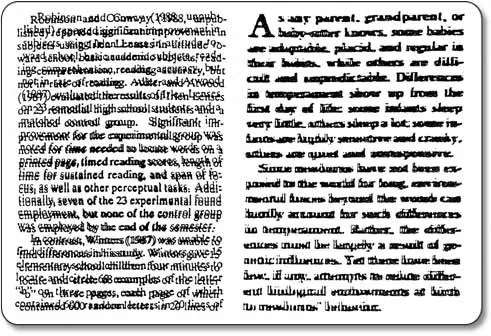
Dyslexia itself is not a vision problem, but many students with learning difficulties also experience visual stress (sometimes called Meares-Irlen syndrome): lines of text seem to blur, shift or run together, which causes reading difficulty, eye strain and headaches. The simulation below gives an idea of what that can look like.
Compensatory tools
While decoding skills are being built — or for persistent cases — compensatory tools allow the child to keep progressing despite their difficulties:
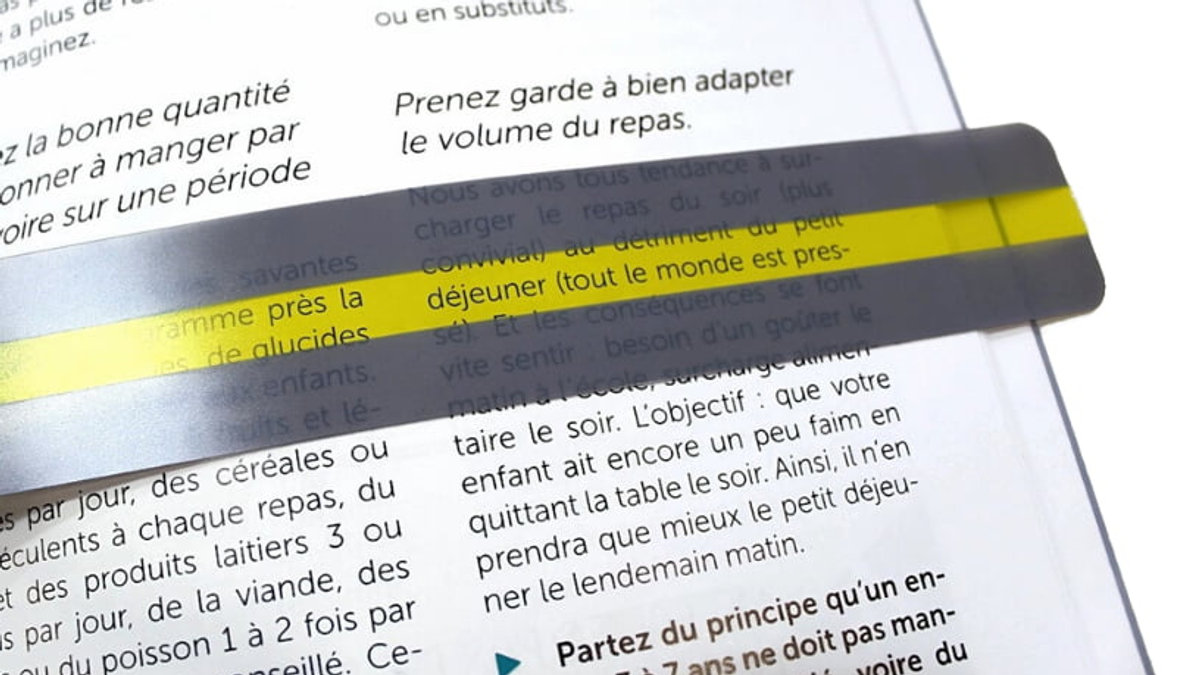
- Colored reading ruler — isolates one line at a time to reduce line-skipping and visual fatigue. Explore our reading aids for dyslexic children.
- Adapted font — OpenDyslexic and the Dyslexie Font modify letter shapes; some readers prefer them, but studies have not found that they improve reading speed or accuracy (Wery & Diliberto, 2017).
- Audiobooks and text-to-speech — let the child access academic content without being blocked by decoding.
- Writing-support software — word prediction tools (WordQ, etc.) reduce the spelling load and free cognitive energy for actual thinking.
| Tool | Need addressed | Key advantage |
|---|---|---|
| Reading ruler | Line tracking, visual fatigue | Simple, portable, effective from age 6 |
| Text-to-speech | Access to longer texts | Preserves comprehension without decoding |
| Adapted font | b/d, p/q confusion | Free and applicable everywhere |
| Audiobooks | Reading enjoyment, vocabulary | Keeps motivation and love of stories alive |
| Structured literacy | Decoding, phonology | The only approach that addresses the root cause |
Supporting your dyslexic child at home
School is not the only place where support happens. At home, the parent's role is central — not to "teach reading" in place of the SLP, but to build a warm, stimulating environment that protects the child's self-confidence:
- Read together every day, but let the child listen while you read aloud. The pleasure of a good story must not be sacrificed to decoding practice.
- Celebrate their strengths: memory, creativity, spatial intelligence, verbal reasoning — children with dyslexia often excel in areas school rarely measures.
- Mark every bit of progress, however small. Self-confidence is the single most powerful driver of learning.
- Avoid asking them to read aloud in public until they feel ready: shame is the number-one enemy of progress.
- Use a reading ruler during homework to isolate each line and reduce cognitive load. See our dedicated article on the reading ruler for dyslexia.

Important reminder: dyslexia frequently co-occurs with other differences — ADHD, developmental language disorder and dyscalculia among them. If your child shows multiple difficulties, a full neuropsychological evaluation is recommended to map the complete picture of their needs.
Working with the school: rights and steps to take
Getting the right accommodations in place can fundamentally transform a dyslexic child's school experience. Here is how to navigate the process effectively:
- Inform the classroom teacher at the start of the year — open communication prevents misunderstandings and sets the stage for collaboration between school and home.
- Share a copy of the diagnostic report with the principal and teacher — it documents the needs on which accommodations are based.
- Request an individualized education plan (IEP) — this official document lists the adaptive measures for your child and commits the entire school team.
- Reassess regularly — needs evolve; an annual check-in with the SLP allows strategies to be fine-tuned throughout the year.
- Explore outside-school resources — parent associations for children with dyslexia, support groups, and learning aids designed for special needs.

Dyslexia differently: strengths worth celebrating
Talking about dyslexia only in terms of deficits would be incomplete — and unfair. Many people with dyslexia describe associated strengths that deserve to be recognized and cultivated from childhood (research on a specific "dyslexic advantage" is still mixed):
- Exceptional visual-spatial thinking — the ability to think in three-dimensional images, particularly valuable in architecture, engineering and the visual arts.
- Creativity and problem-solving — a natural aptitude for seeing situations from a different angle and thinking outside the box.
- Big-picture thinking and narrative intuition — many people with dyslexia excel at grasping the overall structure of a complex situation that others struggle to see.
- Empathy and interpersonal intelligence — having overcome obstacles, many develop a keen sensitivity to others' difficulties.

Richard Branson, Steven Spielberg, Henry Winkler — the list of people who have spoken publicly about their dyslexia is long. Many say it shaped, in part, the way they think and solve problems.
To go further with concrete tools, explore our selection of reading aids and educational toys designed for different learners — and check our full guide to wholesale learning aids and teaching resources if you are an educator or school administrator. Schools and retailers can also buy our reading aids wholesale.