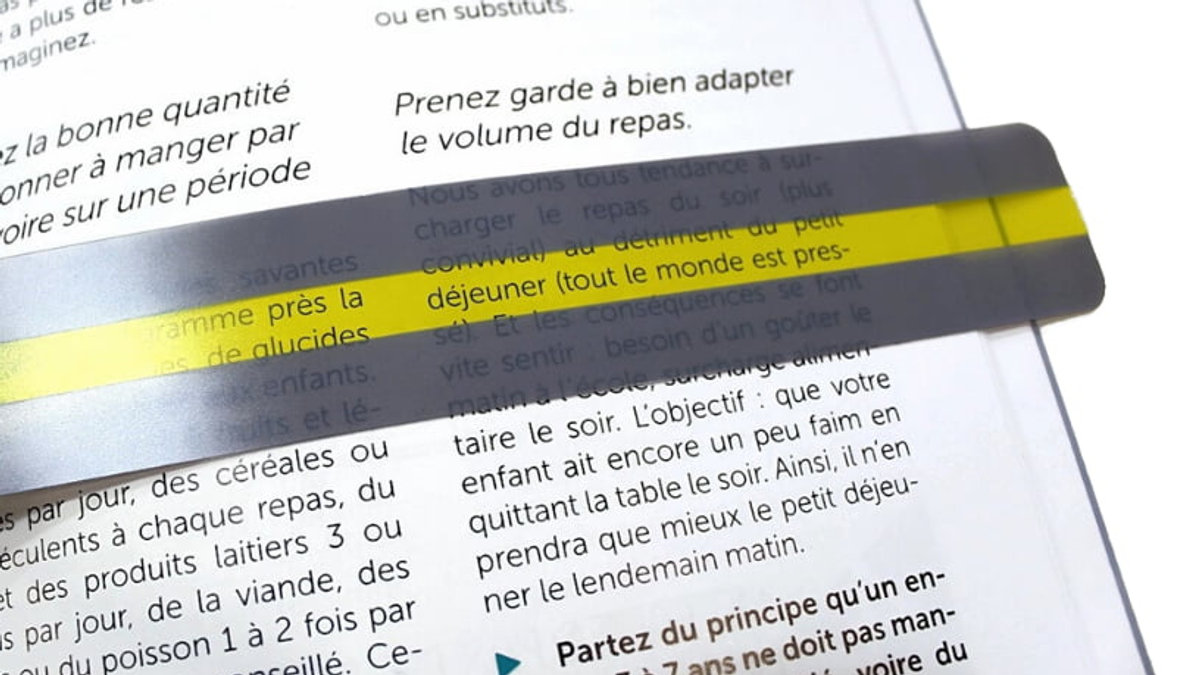

Reading aids for dyslexia — colored rulers, adapted fonts, highlighters and text covers — can reduce visual confusion and ease the effort of reading. They do not cure dyslexia, but they can make reading less exhausting, more fluid and, above all, more accessible every day.
Does your child reverse letters, skip lines or lose their place mid-sentence? These difficulties don't reflect their intelligence — they often signal dyslexia, a learning difference that persists into adulthood. Estimates vary with the definition used — from about 5–10 percent of children to as many as 15–20 percent showing some signs (Dyslexia Canada, citing the International Dyslexia Association). The good news: there are concrete reading aids that can make daily reading easier.
Reading aids are not a substitute for speech-language therapy or evidence-based reading instruction, but they can usefully complement them. By reducing visual and cognitive fatigue during reading sessions at home and in class, they free up mental energy for comprehension instead of pure decoding. Here is a practical overview of the most effective tools and how to weave them into your child's routine.
Understanding the visual challenges that reading aids for dyslexia address
Dyslexia is primarily a phonological disorder — difficulty mapping sounds to letters — and some dyslexic children also report visual discomfort when reading. Some describe letters that seem to "move," "vibrate," or "merge" on a white page.
Irlen Syndrome
This phenomenon, sometimes called visual stress, scotopic sensitivity or Irlen Syndrome, is controversial: it is not a recognized medical diagnosis, and it is not the cause of dyslexia. Some children say colored filters — reading rulers, overlays or tinted lenses — make the page more comfortable, but reviews have not found reliable evidence that they improve reading in dyslexia (see the joint statement of U.S. paediatric and eye-care organizations). They are worth trying for comfort, not as a treatment.
Confusion between symmetric letters
The letters b, d, p and q are mirror images of one another. Reversing them is common in all beginning readers; for dyslexic children, who find it harder to link letters and sounds, the confusion can last longer. Visual markers and mnemonic aids help anchor these distinctions so they become automatic over time.
Losing one's place on the page
Jumping to the wrong line, re-reading the same line, or drifting across a paragraph are common experiences for dyslexic readers. A text cover or reading ruler solves this directly by exposing only one line at a time, removing the visual noise of surrounding text entirely.
The colored reading ruler: the most accessible reading aid for dyslexia
The colored reading ruler is the entry-level tool par excellence. It is a strip of tinted transparent plastic that the child slides beneath each line as they read. Simple, durable, inexpensive — and helpful for many children.
How it works
The ruler's main job is to draw the eye to one line and keep it from wandering between lines; some children also find the tint gentler than bright white paper. Many feel less tired and more confident with it, even though research has not shown that the color itself improves reading for most dyslexic children.

Which color should you choose?
There is no universal answer. Research — notably the work of Arnold Wilkins at the University of Essex — suggests that, for people who benefit from a tint, the preferred color varies from one person to another. The most reliable method: let the child try several colors and observe which brings the most relief. The most popular tints are yellow, pale pink, aqua and lilac.
Tip: buy an assortment of colors rather than a single ruler. Let your child test them over a week and pick their own. That element of choice builds buy-in and a sense of ownership over the tool.
For a deeper look at this specific tool, see our full article on the reading ruler for dyslexia.
Other visual reading aids that help dyslexic children
The colored ruler is only a starting point. Several other tools round out an effective set of reading aids:
The text cover (reading window)
A text cover is an opaque sheet with a rectangular cutout that exposes only one line or a short paragraph at a time. By masking the rest of the page, it removes all competing visual information and keeps the eye exactly where it needs to be. Some children prefer this to a color overlay, especially when reading black-on-white high-contrast text.
Pastel highlighters
Highlighting every other line (with a pale yellow highlighter, for example) creates a visual effect similar to a reading ruler, but embedded directly in the document. This works well for handouts and photocopied worksheets. A teacher can prepare pages in advance, or the child can do it themselves in seconds before a reading session.
Screen color overlays
More and more reading happens on tablets and computers. Browser extensions like Beeline Reader apply a color gradient across lines to guide the eye from left to right without losing it. Dedicated apps also allow changing the background color of web pages or PDF documents to a warmer, lower-contrast tone.
Typography and layout: overlooked reading aids for dyslexia
The visual environment of a text matters as much as any physical tool. A few layout adjustments can transform the reading experience for a dyslexic child:
| Setting | Recommended value | Why it helps |
|---|---|---|
| Font | Arial, Verdana, OpenDyslexic (12–14 pt) | Clear, distinct letterforms; no dense serifs |
| Line spacing | 1.5 to 2 | Reduces confusion between lines |
| Line length | 60–70 characters maximum | Limits eye-travel distance |
| Background color | Cream, pale yellow or soft grey | Cuts glare and contrast fatigue |
| Letter spacing | Slightly increased (tracking +10 %) | Reduces crowding between adjacent letters |
These settings are especially easy to apply to digital documents. Most word processors — and the iPads increasingly common in classrooms — allow these adjustments in just a few minutes.
Good to know: the OpenDyslexic font is a free download. Its letters have a heavier base meant to anchor them visually. It is not a magic fix — a 2017 study found no improvement in reading speed or accuracy — but some children simply prefer it, and comfort matters.
Audio and technology: powerful reading aids alongside visual tools
Visual aids are essential, but they are not the whole picture. Audio and technology tools open a complementary path that is especially valuable for children with more severe dyslexia.
Text-to-speech software
Apps like Voice Dream Reader, Snap&Read or the built-in iPad reader read text aloud while the child follows along — or simply listens. This approach decouples access to information from decoding, letting the child grasp content without being blocked by difficult words. Used strategically, it is a bridge that keeps reading motivation alive.
Reading aloud together
Simple but very useful. Shared reading — an adult reads a sentence, the child repeats it, or they trade off — builds fluency and reinforces the prosodic model of language. It is also a meaningful moment of connection, especially when reading is often associated with frustration and failure.
Audio versions of school textbooks
In Canada, children with a formal dyslexia diagnosis can often obtain textbooks in audio or digital-accessible format through their school board or publishers' accessible-format programs. Request this accommodation at the start of the school year — don't wait until your child is already falling behind.
A dyslexic child who gets access to audiobooks discovers that they love stories — even when printed words are a struggle. That discovery is often the beginning of a more peaceful relationship with reading. — The Robiii team
Using reading aids at home and in the classroom
Having the right tools is only half the equation — they need to be used consistently and in a positive spirit. Here is how to support adoption in both settings:
At home
- Create a dedicated reading corner: good lighting (natural light or a warm lamp, never cool direct overhead lighting), a cream-colored work surface, and a reading ruler within easy reach.
- Keep sessions to 15–20 minutes before a break. Cognitive fatigue accumulates quickly for dyslexic children; short, regular sessions outperform one long exhausting sitting.
- Praise effort, not outcome: "You read that whole page with your ruler — that's great!" rather than "You made mistakes again."
- Allow movement: some children read better standing up, walking slowly, or sitting on a stability cushion. Don't insist on a rigid posture if it isn't necessary.
In the classroom
- Ask that reading aids be written into the student's Individual Education Plan (IEP) as official accommodations, not just informal suggestions.
- Make sure the teacher has a set of colored reading rulers available to the whole class — this normalizes the tool and removes any stigma for the child who needs it most.
- Request that handouts be printed on cream-colored paper or distributed in an editable digital format.
- Explore computer-assisted reading tools with the school's learning specialist or resource teacher.
For a broader look at teaching resources and wholesale educational tools, our guide to learning aids and teaching toys is a useful companion reference.
Choosing your reading aids: where to begin
Faced with so many options, it can be hard to know where to start. Here is a sensible, progressive approach:
- Start with a colored reading ruler: the lowest-cost, most immediate investment. Buy an assortment of colors and trial them for one to two weeks.
- Adjust digital typography: font, line spacing, background color — free changes that make a real difference in daily screen reading.
- Introduce a text cover if your child still skips lines despite using a colored ruler.
- Explore text-to-speech for long or challenging texts, as a complement to visual reading rather than a replacement.
- Consult a speech-language pathologist for a full assessment and personalized recommendations tailored to your child's specific profile.
If you want to build a stronger foundation before choosing tools, our article What Is Dyslexia? covers the key signs and underlying mechanisms in plain language. You can also browse our range of educational tools in the Robiii store to find options suited to your child's needs.