
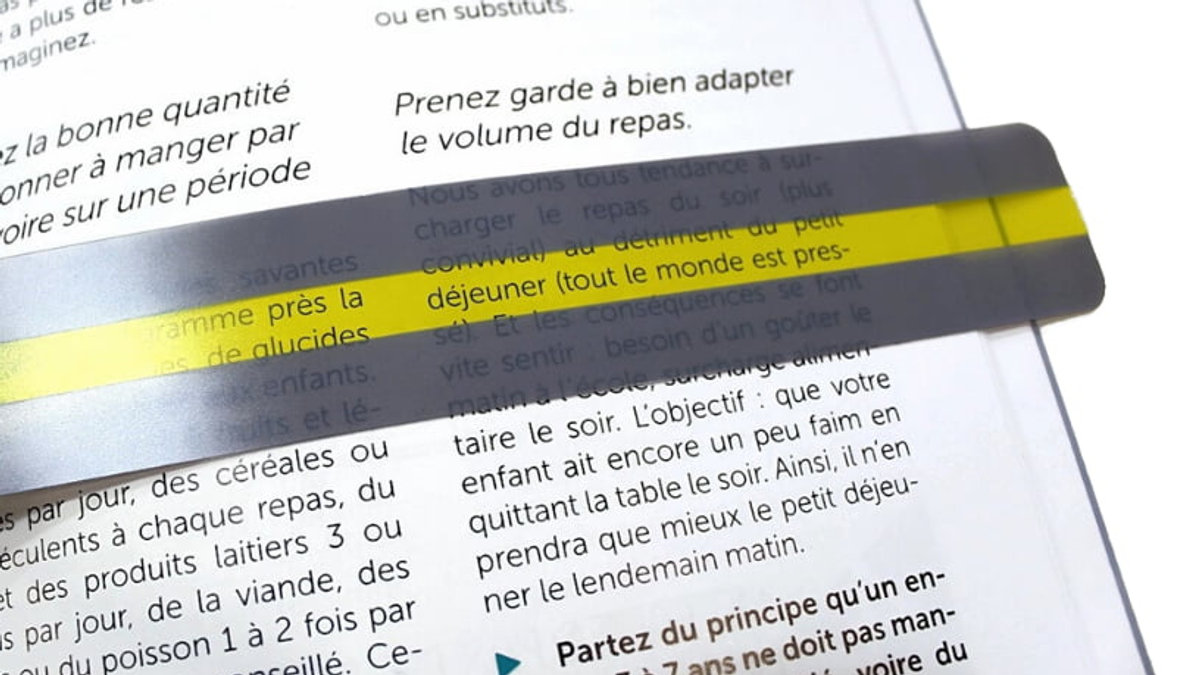
A reading ruler (also called a dyslexia ruler or reading guide strip) is a thin, tinted plastic strip you lay on the page to highlight one line of text at a time. It helps readers keep their place, skip fewer lines and soften the glare of white paper. It is a reading accommodation, not a treatment for dyslexia.
Does your child re-read the same line several times without noticing, lose track mid-sentence, or complain that letters "move" on the page? These signs are common in children with dyslexia — and they have nothing to do with a lack of effort or intelligence. They reflect a different way of processing visual and phonological information. Fortunately, simple, affordable and immediately accessible tools can make a real difference in a child's daily reading experience.
The colored reading ruler is one of the simplest and most discreet of these tools. In this guide we explain what it is, how to use it step by step, how to choose the right color and size, who it can help — and what the research does and does not say. You will also find pointers to other reading aids for dyslexic children to round out your support toolkit.
What is a reading ruler?
A reading ruler — also called a dyslexia ruler, reading guide strip or line tracker — is a thin sheet of flexible plastic, transparent or semi-transparent, lightly tinted in a particular color. You slide it over the printed page so that it covers and isolates the line you are currently reading.
It works on three levels:
- It frames the active line visually and partially masks the lines above and below, reducing visual overload.
- It softens the brightness of the white page background, which can feel harsh to children sensitive to contrast.
- It provides a visual anchor the eye naturally returns to, limiting unintentional line-skipping.
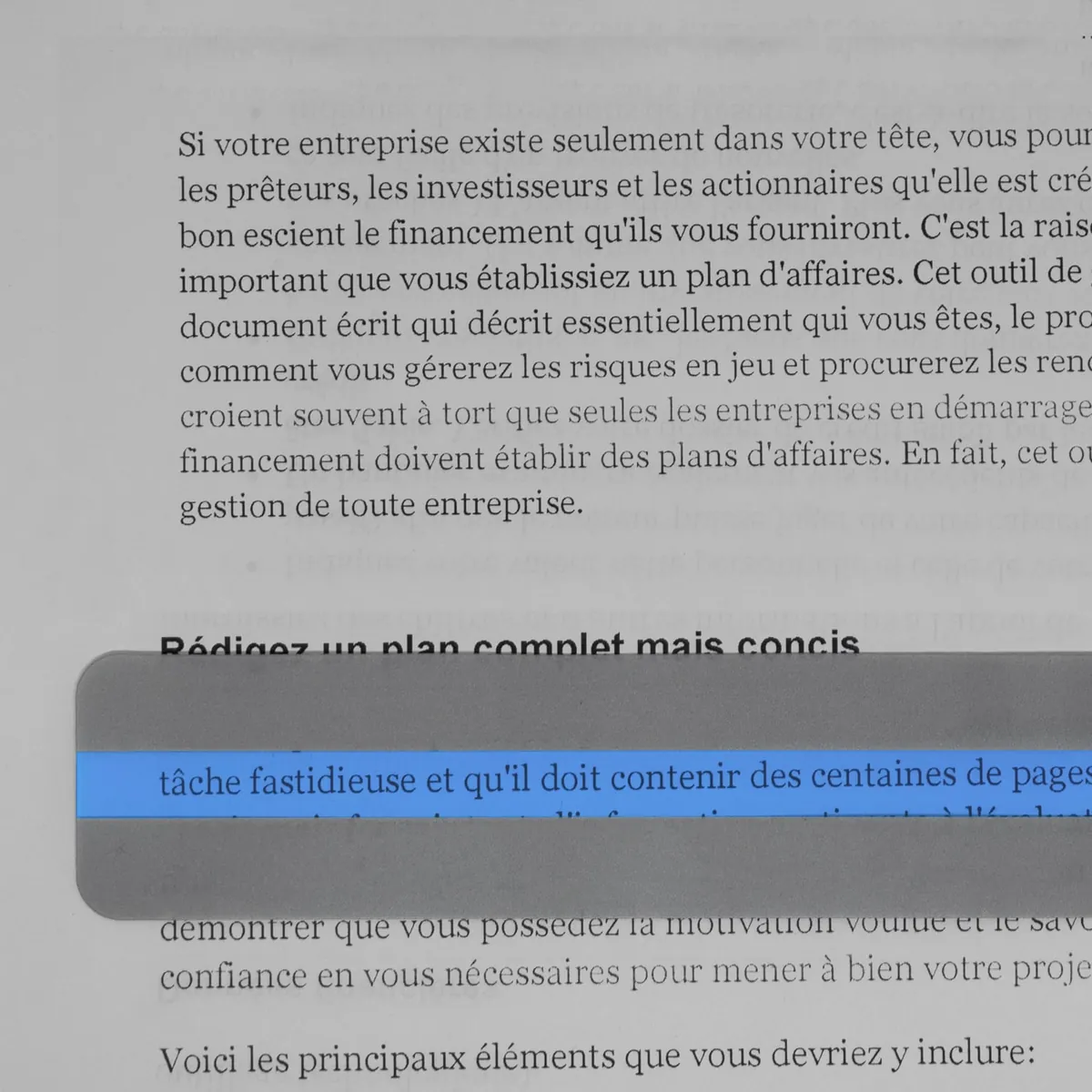
A reading ruler is not a medical device — it is a pedagogical support tool that can be written into an individualized education plan (IEP) and is suggested by some speech-language therapists and special education teachers.
The main types of reading rulers
- Highlight-strip rulers: a clear colored band runs along the middle while darker tinted edges dim the lines above and below. This is the design of Robiii's reading rulers.
- Window (slot) rulers: an opaque or tinted card with a narrow cut-out that shows only one line. Some have two windows: a narrow one for single lines and a wider one for paragraphs or tables.
- Plain tinted strips: a colored see-through bar placed over or just under the line, with no masking.
- Digital reading rulers: an on-screen bar offered by some browser extensions, e-readers and accessibility software.
Reading rulers come in different colours and sizes, and some models add a built-in magnifying strip that enlarges the line being read. Robiii's reading ruler also comes in a larger XL version. Beyond dyslexia, a reading ruler can also help children with other difficulties that affect reading and language processing (see who it can help).
Good to know: some children who report visual discomfort when reading (sometimes called visual stress or Irlen syndrome, a contested concept) say a tinted ruler makes reading more comfortable. However, major pediatric and eye-care organizations state that tinted filters or lenses do not treat dyslexia, which is a language-based difficulty (AAP/AAO joint statement).
How to use a reading ruler, step by step
A reading ruler takes about a minute to learn. With a highlight-strip ruler like Robiii's:
- Let the reader choose the color. Have them read the same short passage with each tint for a few minutes, then keep the one they say feels easiest on the eyes. There is no "right" color.
- Lay the ruler flat on the page with the colored band over the first line to read. On a window ruler, the line sits in the cut-out; with a plain strip, place the edge just under the line.
- Read along the band from left to right. Younger readers can also run a finger along the band to keep pace.
- Slide the ruler down one line at the end of each line. The band shows exactly where the next line starts, which helps avoid skipping a line or reading the same one twice. Let the reader move it at their own pace.
- Try it for a week or two, then check in. Ask whether reading feels easier or less tiring. If it does not help, try the other color, a wider size or a different tool — and set it aside if it is not useful.
How to choose a reading ruler: color, size and type
Color
There is no universally superior color. Children who use colored overlays often prefer different colors, so let your child try a few. The table below lists common starting points reported by readers and teachers — they are not research-based rules:
| Color | Often tried by | What some readers report |
|---|---|---|
| Yellow | Readers bothered by glare or brightness | The white page looks less harsh |
| Pale blue | Readers who say letters look unstable | Text looks steadier and less stark |
| Green | Readers whose eyes tire quickly | Feels more restful over longer reading |
| Pink / purple | Readers sensitive to strong contrast | Softens the black-on-white contrast |
| Orange | Readers who drift off the line | A warm tint some find easier to stay on |
The most reliable method remains a side-by-side trial: offer the child two or three different colors, have them read a short passage with each one, then ask which feels most comfortable. The child is the best judge of their own perception. Robiii's reading rulers come in blue and yellow — buying one of each is an easy way to run that test at home.
Size: standard or XL?
Match the ruler to what the child reads most. A standard reading ruler suits novels, early readers and smaller books, and slips easily into a pencil case. An XL ruler spans the full width of a book page or worksheet, so it is the better choice for textbooks, workbooks and printed class handouts.
Tip: if your child will use the ruler at school, choose one wide enough to cover a full line of their textbook or worksheet — that is what the XL format is for. A ruler that is too narrow will need to be shifted sideways mid-sentence, interrupting the reading flow.
Type and band height
- Highlight strip: colored band plus dimmed edges — a good all-rounder for books and worksheets.
- Window (slot) ruler: masks everything except one line — useful for readers who are very distracted by the surrounding text.
- Full-page overlay: tints the whole page but does not isolate a line (see the comparison below).
- Band height: a narrow band shows a single line of small print; a wider band shows one or two lines, which suits large print, early readers and tables.
Robiii's reading rulers: standard or XL
Both of Robiii's reading rulers use the same highlight-strip design, come in blue or yellow and ship from Québec.
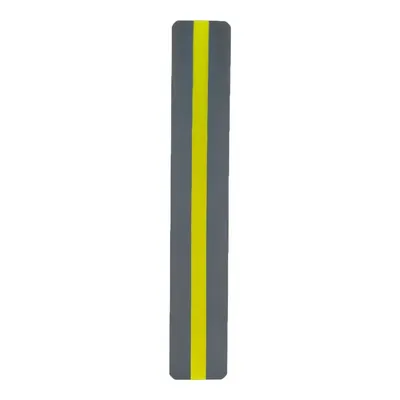
Robiii · Standard size
Reading Ruler
Tinted highlight strip for novels, early readers and everyday homework. Blue or yellow, recommended from age 5, sold individually.
$1.99 CAD · See the reading ruler →
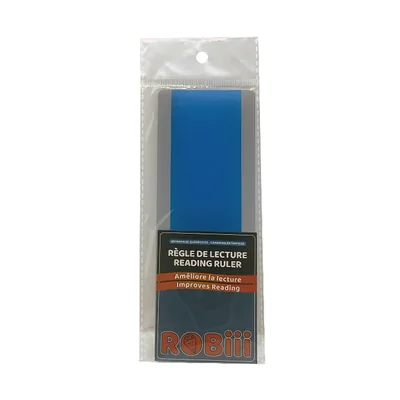
Robiii · XL size
Reading Ruler XL
Wider format that spans the full width of a book page or worksheet — ideal for textbooks and longer passages. Blue or yellow, from age 4.
$2.99 CAD · See the XL reading ruler →
Free shipping on orders over $50. Buying for a classroom, clinic or store? See our wholesale program.
Reading ruler vs colored overlay vs finger or bookmark
A reading ruler is not the only way to keep your place. Here is how the common options compare:
| Tool | How it works | Best for | Limits |
|---|---|---|---|
| Reading ruler | Tinted strip that highlights one line and dims the lines around it | Keeping your place line by line in books and worksheets | Has to be moved line by line; a small ruler may not span a wide page |
| Full-page colored overlay | Tinted sheet that covers the whole page | Readers who mainly want to soften white-page glare | Does not isolate a line; bulkier; evidence on tints is mixed |
| Finger or reading finger | Points to the word or line being read | Beginning readers learning to follow words | The hand can hide text; does not mask other lines |
| Bookmark or index card | Plain card placed under the line | A free, quick test of whether line-masking helps | No tint or highlight; only hides the lines below |
| Digital reading ruler | On-screen bar that highlights a line | Reading on a computer, tablet or e-reader | Screens only |
In short: if the main problem is losing your place, a reading ruler or window ruler is the most direct fit. If the reader mostly complains about glare, a full overlay may be enough. A plain index card is a free way to check whether line-masking helps before buying anything.
Who can a reading ruler help?
Reading rulers are most associated with dyslexia, but the people who tend to find them useful share one thing: they lose their place on the page, or find a full page of text visually tiring.
- Children with dyslexia: mainly to keep their place and skip fewer lines. A ruler does not address decoding — the core difficulty in dyslexia — so it works alongside structured reading instruction, not instead of it.
- Readers who skip or repeat lines (visual tracking difficulties): showing one line at a time is the most direct, practical benefit of a reading ruler.
- Children with ADHD or who are easily distracted: fewer lines in view means less competing for attention, and some children find it easier to stay on the text.
- Early readers: children still learning to move left to right and from one line to the next can use it as a temporary guide, then phase it out once tracking becomes automatic.
- Teens and adults: for dense textbooks, forms, spreadsheets and fine print, or for anyone who finds the glare of white paper uncomfortable.
An honest word on the evidence: as noted above, research on colored overlays is mixed and tinted filters do not treat dyslexia (AAP/AAO joint statement). The place-keeping benefit, though, is simple to check for yourself: if a reader finds the ruler helps, it is a cheap, low-risk accommodation; if not, move on.
Why a reading ruler helps dyslexic children
Dyslexia is a lasting reading acquisition difficulty that affects an estimated 5 to 10 percent of children. Its main feature is impaired phonological decoding — the brain struggles to map sounds onto letters. Some children with dyslexia also report visual discomfort when reading: letters that appear to shift or shimmer, glare sensitivity and confusion between visually similar letters (b/d, p/q).
That is exactly where the reading ruler steps in:
Reducing visual load
On a dense page of text, the dyslexic child's brain is often overwhelmed by too much visual information at once. The colored strip acts as a gentle "mask" that reduces the number of simultaneously visible lines, lightening the cognitive load and allowing full attention to land on the one line that matters.
Stabilizing letter perception
Some children describe letters as "wobbling" or "moving around." Some children say a tinted filter makes letters look steadier. Research on colored overlays has produced mixed results and they do not treat dyslexia — but if a child reads more comfortably with one, it can be a reasonable accommodation.
Building self-confidence
Often, the psychological effect is just as important as the visual one. A child who feels less fatigued after reading, who skips fewer lines and who makes steadier progress gains in self-esteem — a critical lever for sustaining motivation over the long run.
"When reading becomes a little less tiring, some children stop saying they 'hate reading.' They may still read slowly, but they give up less quickly." — The Robiii team
Building the reading ruler into your daily routine
The most useful tool in the world does nothing if it stays at the bottom of the school bag. Here are practical ways to make it a natural habit:
At home
- Always store it in the same spot — in the pencil case or tucked inside the reading book — so it is found instantly.
- Present it as a tool, not a fix: call it a "reading helper," let the child pick the color, and show that adults use reading aids too.
- Use it yourself occasionally: normalize the tool by showing that anyone can benefit from a reading aid.
- Pair it with a positive moment: a quiet bedtime story the child chose, with no performance pressure.
- Celebrate small wins — one extra line read without an error, one paragraph completed in a single pass.
In the classroom
- Tell the teacher early in the year and include the tool in the child's IEP if one exists.
- Keep a spare — one ruler at home, one at school — to avoid the "I forgot it" problem.
- Test it on photocopies: some colors are less effective on black-and-white photocopied sheets than on freshly printed pages.
A reading ruler works best as one part of a comprehensive support plan: speech-language therapy, evidence-based reading instruction, classroom accommodations and complementary tools such as clear sans-serif fonts (Arial, Verdana) or text-to-speech software. To explore these strategies further, visit our article on learning aids and teaching resources.
Other tools to support reading in dyslexic children
The reading ruler is often the first accommodation introduced — simple, inexpensive and non-stigmatizing. It works even better alongside other resources:
- Annotated bookmarks: a thick bookmark placed under the active line creates a visual anchor even without a color filter.
- Dyslexia-friendly fonts: plain sans-serif fonts such as Arial, Verdana or Trebuchet MS are recommended in the British Dyslexia Association's style guide; specialized fonts such as OpenDyslexic have not been shown to improve reading speed or accuracy (Wery & Diliberto). Many teachers can adapt their handouts to these fonts with minimal effort.
- Text-to-speech software: hearing text read aloud while following it with the eyes simultaneously reinforces comprehension and decoding skills.
- Larger print: the British Dyslexia Association suggests 12 to 14 pt text with 1.5 line spacing, which many readers find easier on the eyes.
- Alternating-line paper: some notebooks and worksheets alternate between two background shades to help distinguish lines — the same principle as the reading ruler, built right into the paper.
If you want to equip a full classroom or order in bulk for your store, our range of reading aids offers options to suit every budget and every grade level.
Important: a reading ruler is not a substitute for a professional assessment. If you suspect your child has dyslexia, consult a speech-language therapist or neuropsychologist to obtain a formal diagnosis. A diagnosis opens the door to official accommodations such as extra time on tests and a personalized IEP.
Understanding dyslexia to make the most of your tools
To get the most out of a reading ruler, it helps to understand what is actually happening in a dyslexic child's brain. Dyslexia is not a vision disorder — it is a neurological condition that affects the brain region responsible for processing written language. This is why vision exercises alone do not "fix" dyslexia, even though they may improve reading comfort.
Dyslexia occurs across the whole range of intelligence. Many children with dyslexia have strengths in creativity, visual thinking or problem-solving. The difficulty lies specifically in decoding written symbols, which makes reading slow and exhausting, but says absolutely nothing about their intelligence or potential.
To deepen your understanding of the condition and discover the most effective support strategies, our article "What Is Dyslexia? Understanding and Supporting Your Child" is an excellent starting point. It offers clear explanations of the brain mechanisms involved, early signs to watch for and resources available in Canada.
For schools and distributors: offering this tool at scale
If you are a teacher, school administrator, speech-language therapist or retailer, you know that demand for quality reading aids is strong and consistent. Reading rulers typically start as small orders and quickly become full-case purchases once you have seen the impact firsthand.
At Robiii, we supply these reading aids at competitive wholesale prices, with minimum order quantities accessible to both small schools and large retail chains. Our products meet Canadian safety standards and ship anywhere in Canada within a few business days.
- Reading rulers available in multiple colors and widths.
- Discreet individual packaging sized to fit in a pencil case.
- Volume pricing from as few as 12 units.
- Bilingual customer service dedicated to institutional orders.
Visit our online store, see our wholesale program or contact us for a group pricing quote.