
The giant sand timer turns an abstract idea — time passing — into a visual, silent and concrete cue. For a child with ADHD who experiences "time blindness," watching the sand fall is worth a thousand reminders. It frames transitions, homework and routines with no shouting and no negotiation.
"Two more minutes!" How many times a day do you repeat that phrase? For many children — and especially those living with attention-deficit/hyperactivity disorder (ADHD) — those two minutes mean nothing. Time stays vague, elastic, impossible to grasp. The result: transitions that blow up, homework that drags on, and morning battles.
The giant sand timer answers this problem with disarming simplicity. No screen, no app, no stressful alarm: just colored sand falling, slowly and surely. Here is why this wonderfully simple tool has become a classroom and household staple, and how to get the most out of it.
What is a giant sand timer?
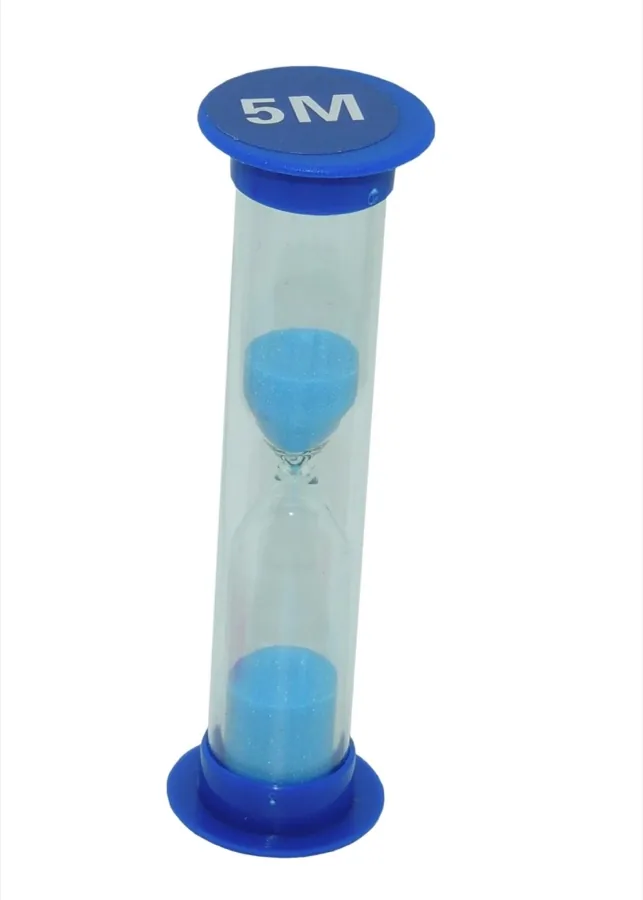
A giant sand timer is an oversized version of the classic hourglass: two glass or plastic bulbs joined by a narrow neck, filled with colored sand that flows from one chamber to the other over a fixed duration. The difference from a kitchen timer? Everything is visual. The child has nothing to read, nothing to interpret: they see time disappear.
Its large size also makes it an appealing, almost hypnotic object. The steady movement of the sand has a recognized calming effect, making it both a sensory tool and a time cue.
Why time is a challenge for children with ADHD
Clinicians call it "time blindness": a difficulty, common in ADHD, in perceiving and estimating elapsed time — a 2022 meta-analysis of 27 studies found that children and teens with ADHD judge time less accurately than their peers (Zheng et al.). For some of these children, five minutes and half an hour can feel much the same. It is not defiance — it is a real neurological difference.
This trait explains many daily frictions:
- Transitions (stopping play to come to the table) trigger meltdowns and resistance.
- Homework feels endless, which discourages a child before they even start.
- Routines in the morning and evening stretch on forever.
- Repeated verbal reminders end up feeling like "nagging," with no real effect.
Good to know: making time visible does not "cure" ADHD, but it transfers responsibility for time from you to a neutral object. The child no longer fights you: they race the timer.
How the giant sand timer helps in practice
By turning time into visual information, the timer works on several levers at once:
It externalizes time
The child no longer needs to "feel" time: they see it. This externalization eases their mental load and reduces the anxiety tied to uncertainty ("how much longer?").
It defuses conflict
The timer becomes the neutral authority. It is no longer mom or dad who "decides" it is time to stop: it is the sand. Negotiations drop sharply.
It soothes through movement
Watching the sand flow has a centering effect, close to that of a stress-relief object. Many children use it spontaneously to bring their pressure down.
Why a sand timer beats a digital timer
Unlike a digital timer, a sand timer gives a physical, visual representation of time: the amount remaining is visible at a glance, with no need to read numbers or count. That is why it can ease transition anxiety, build independence and perseverance, and works from age 3.
Robiii product
Giant Sand Timer
Oversized colored-sand timer, perfect for making time visible at home and in the classroom. Silent, battery-free, from age 3.
$19.99 CAD · View in store →
Choosing the right duration
A timer measures only one duration, so the choice matters. Here is a simple guide for the most common uses:
| Duration | Best use | Why |
|---|---|---|
| 1–2 min | Tooth-brushing, putting a game away | Short tasks children tend to rush |
| 5 min | Transition, last round of play | Prevents end-of-activity meltdowns |
| 10–15 min | Homework or reading session | Breaks effort into manageable blocks |
| 30 min | Screen time, free play | Frames a "privilege" time with no reminders |
The Robiii giant sand timer comes in eight durations: 1 min, 2 min, 3 min, 5 min, 10 min, 15 min, 20 min and 30 min.
Tip: many families own two or three timers of different durations. The child picks the one that fits the task — that sense of control boosts buy-in.
7 ways to use it at home and in class
- The transition countdown — "When the sand is at the bottom, we tidy up and head to the bath."
- Homework blocks — a 15-minute timer breaks up the work and makes the end visible.
- The morning routine — one timer per step (getting dressed, breakfast, teeth) to move along without reminders.
- The calm-down break — watching the sand fall to come down after a meltdown or recess.
- Sharing screen time — the timer makes the limit concrete, with no debate.
- Classroom activities — the teacher frames center rotations with a single gesture.
- Turn-taking — each child speaks while the sand flows, then passes it on.
Occupational therapists also use the sand timer to work on frustration tolerance and the concept of duration with autistic children.
Usage tips and mistakes to avoid
To make the timer a real ally rather than a forgotten gadget:
- Introduce it positively, as a game, not as a punishment or a source of pressure.
- Place it at the child's eye level, clearly visible on the desk or table.
- State the rule once, then let the timer do the work — resist the urge to comment.
- Don't use it for everything: save it for 2 or 3 key moments so it keeps its power.
The timer does not replace your support: it makes it gentler. The child stops being subject to time and starts reading it. — The Robiii team
Combined with other ADHD strategies and good stress-management tools, the giant sand timer becomes a simple, remarkably effective building block of daily life.
For schools, clinics and stores, the giant sand timer is also available wholesale (suggested retail price: $19.99): wholesale pricing is reserved for registered retailers, with a $200 minimum order and delivery in 3 business days. We recommend an assortment of durations to cover every context, from toothbrushing to homework blocks.