Saving on school supplies does not mean buying less — it means buying smarter. Buying in bulk, taking advantage of end-of-season sales, and pooling orders with other parents or teachers are the most powerful levers for cutting costs significantly without compromising on quality.
Back to school season brings excitement — and, all too often, a stack of receipts. Notebooks, pencils, erasers, rulers, glue sticks, scissors, backpacks: the list grows fast, and the total can easily climb into the hundreds of dollars per child. For larger families, teachers who stock their own classrooms, or school administrators managing tight budgets, the bill can be even heavier.
The good news: saving on school supplies does not require hunting every sale in town or settling for inferior products. A few smart buying habits are all it takes. Here are ten proven strategies — from the simplest to the most impactful — to lighten the load while making sure students have everything they actually need.
1. Buy in bulk: the number-one way to save on school supplies
Whether you are a parent of several children, a teacher, or a school purchasing manager, buying in large quantities remains the most reliable way to reduce the unit cost of school supplies. A single pencil at a neighborhood stationery store might cost $0.75. The same pencil bought in a box of 144 often works out to under $0.20 each — a saving of more than 70%.
What to buy in bulk
Not every item is worth buying in large quantities. Focus on high-turnover products with a long shelf life:
- Pencils and colored pencils
- Notebooks and loose-leaf paper
- Pens, markers and highlighters
- Glue sticks and tape
- Erasers and pencil sharpeners
- Construction paper and craft cardstock
For specialized learning aids and educational materials — reading rulers, writing boards, sensory tools — buying wholesale from a specialist like Robiii offers preferential rates for schools and educators that general retailers simply cannot match.
Tip: before placing a bulk order, take stock of what you already have. Real savings only come when you actually use what you buy.
2. Pool orders with other parents or teachers
Most wholesalers require a minimum order to unlock bulk pricing. The solution? Organize group purchases. Five or ten parents ordering together easily clear the minimum threshold and split the savings among themselves.
In schools, administration can centralize purchases of shared supplies — paper, chalk, whiteboard markers — and access discounts that no individual teacher could reach alone. Some Quebec school boards run procurement processes that lock in negotiated prices for the entire school year.
How to organize a group purchase
- Draft a shared list of needs by subject and grade level.
- Approach a wholesaler (like Robiii) for a volume quote.
- Divide the cost proportionally based on each participant's quantities.
- Plan distribution at a parent meeting or professional development day.
3. Choose the right time to buy
The calendar is your best ally. School supply prices follow predictable cycles that savvy buyers exploit systematically.
| Period | Opportunity | Typical discount |
|---|---|---|
| May – July | End-of-school-year clearance | Often the deepest discounts |
| Late August | Back-to-school sales at big-box stores | Moderate discounts on basics |
| November | Black Friday and Cyber Monday | Variable (especially tech) |
| December – January | Boxing Day and post-holiday sales | Variable, depending on the item |
| Year-round | Online wholesalers (volume orders) | Lower unit prices on volume orders |
The most budget-conscious parents buy the following year's supplies in July, when end-of-season clearances peak. All it takes is a little storage space and the habit of running a year-end inventory check in June.
Price matching, price adjustments and coupons
- Price matching: several Canadian retailers, including Staples and Canadian Tire, have offered to match a competitor's advertised price. Read the policy first — identical model number, item in stock, request made at the till — then shop at the most convenient store.
- Price adjustments: some stores refund the difference if an item you bought at full price goes on sale within a set window (often 7 to 30 days). Keep your receipts until the end of September.
- Coupons and cash back: flyers, retailer apps and coupon sites such as Save.ca or RetailMeNot.ca list back-to-school promo codes; free browser extensions (Honey) and cash-back sites (Rakuten) apply savings automatically when you buy online.
- Dollar stores: a good source of basic pens, erasers and highlighters — check quality on items that need to last all year.
- Buying online: handy for bulk packs and free-shipping thresholds, but read reviews and be wary of deals that look too good to be true.
4. Reuse, repair and recycle before buying new
Before stepping foot in a store, take stock of what you already have. A pencil case still half full of usable colors, a spiral notebook with pages left, a ruler buried in a drawer: the end-of-year audit often turns up pleasant surprises.
- Short pencils: a pencil extender (just a few cents at wholesale prices) gives them a full second life.
- Partially used notebooks: remaining pages are perfect for rough notes and drafts.
- Backpacks and pencil cases: a thorough cleaning and a few stitches can add another year or two to a bag in good condition.
- Scissors and rulers: these tools last years when cared for properly — no need to replace them every September.
Swap before you shop. Organize a swap with neighbours, friends or other parents from the school: the supplies, backpacks and clothes your children will not use can complete another family's list — and vice versa. For clothing and accessories, thrift stores (Value Village, Plato's Closet, Once Upon A Child or smaller neighbourhood second-hand shops) are a good alternative to buying new. Skip second-hand everyday shoes, though: they mould to the first child's feet and can carry fungal infections.
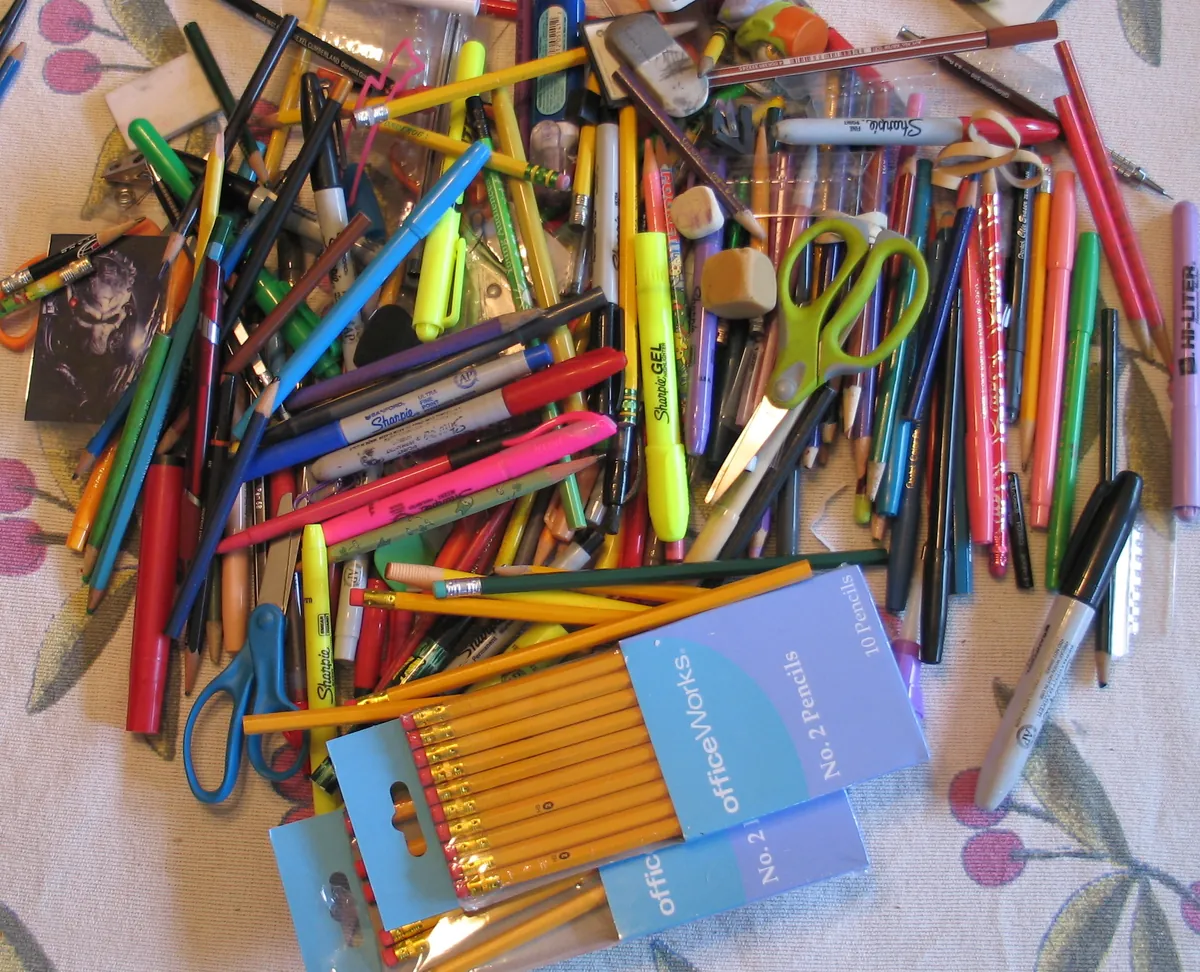
The best school supply is the one you never need to repurchase. A rigorous June inventory is worth as much as a great August sale. — The Robiii team
5. Build a realistic list and stick to it
School supply lists handed out by teachers vary widely. Some items are essential; others are optional or can be shared among students. Learning to tell them apart saves real money.
A classic trap: buying extra items "just in case" — a habit that inflates the bill without any real benefit. Here is how to stay disciplined:
- Check off each item from the school's official list before adding anything else.
- Confirm with the teacher what is truly required versus recommended.
- Resist attractive packaging that doubles the price for the same quality.
- Avoid personalized supplies (printed names, trendy designs) that cost noticeably more.
- Set a price range for each item and involve your children in the budget — a few loonies and toonies from the piggy bank make a great lesson on the value of money.
Good to know: in Quebec, Retraite Québec automatically adds a school supplies supplement to the Family Allowance every July — $127 per eligible child aged 4 to 16 for the 2026–2027 school year, regardless of family income (Retraite Québec).
6. Choose generic brands for consumables
For items that get used up quickly — copy paper, pencils, erasers, glue — generic or store-brand products often deliver perfectly acceptable quality at a fraction of the name-brand price. The quality difference is rarely noticeable in everyday school use.
That said, for tools that require precision and durability — a compass, a set square, a scientific calculator — investing in quality upfront is more economical in the long run. A good compass at $12 will last six years; a $3 one may need replacing every year.
The cost-per-use rule
Before any purchase, ask yourself: how much will this item cost per use over its expected lifespan? A durable, higher-priced item is often cheaper than a disposable budget option. This simple rule prevents false economies.
7. Take advantage of support programs and grants
Many little-known resources can reduce the school supplies bill, especially for lower-income families or schools in underserved communities.
- Provincial and federal programs: the Canada Child Benefit and Quebec's Family Allowance (which includes the school supplies supplement) can offset part of school-related expenses.
- Community organizations: many local groups (United Way, Rotary clubs, school foundations) run drives collecting new or gently used school supplies.
- Corporate donations: some large companies have programs donating office or school materials — it is worth asking your employer.
- School and public libraries: textbooks, dictionaries and atlases can often be borrowed rather than purchased.
8. Work with specialized wholesale suppliers for educational materials
For teachers and school administrators, buying wholesale from a specialized distributor like Robiii offers advantages that big-box stores cannot provide: a selection driven by real educational needs, volume pricing that scales with order size, and personalized guidance.
At Robiii, bulk orders cover everything from standard supplies to specialized educational materials — reading rulers for dyslexic students, sensory toys for inclusive classrooms, fidget tools for students with ADHD. These items, rarely available at reasonable prices in general retail, can be ordered in quantities suited to an entire classroom.
For educators: always ask your wholesaler for a detailed invoice. It supports a reimbursement request to your school board or school service centre — and teachers and early childhood educators who pay for classroom supplies out of pocket may be eligible for the federal eligible educator school supply tax credit (25% of up to $1,000 in eligible purchases).
9. Find the right balance between digital and paper
Going digital reduces consumption of some paper-based supplies, but can introduce new costs — tablets, apps, subscriptions. The smart balance is to digitize where it genuinely adds value, while keeping paper for learning situations where it remains irreplaceable.
Some studies suggest that writing by hand helps young children learn to recognize letters better than typing does (Longcamp et al., 2005). Workbooks and draft paper therefore retain full pedagogical value — and their cost stays very low when bought in bulk.
When it comes to educational toys in the classroom, physical materials — math manipulatives, logic games, sorting tools — offer more hands-on engagement and fine motor practice than most digital equivalents.
10. Plan across the full year, not just at back-to-school time
Most school supply purchases are crammed into two or three weeks in August, when stores are busiest and shelves are most picked over. Spreading purchases across the year — catching flash promotions and off-season clearances — is one of the easiest ways to save without any extra effort.
Try this simple three-step system:
- In June: take stock of what remains, identify next year's needs, and buy end-of-season clearance items while discounts peak.
- In November–December: use Black Friday for technology purchases (calculators, USB drives, headphones) and top up stock on high-use items on promotion.
- In August: all that is left is buying the missing items and any new items listed by the school — much of the bill is already behind you.
For schools and educators, a year-round partnership with a reliable wholesaler simplifies planning even further: one volume order a year, delivered on your chosen date, with no need to track fluctuating retail prices.